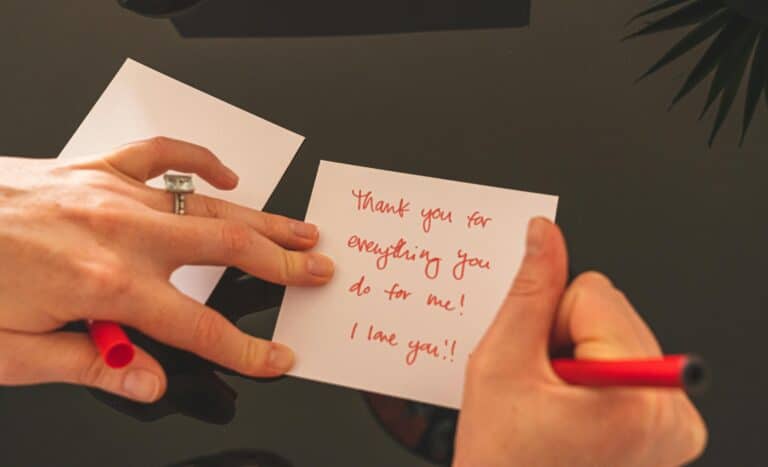
Sending a handwritten note takes about ten minutes. The effect on the person who receives it can last years. Research on gratitude expression and social connection consistently shows that the act of writing a note benefits the sender as much as the recipient, sometimes more. This article covers why the handwritten note produces effects that digital communication cannot replicate, what the research says about both sides of the exchange, and how to actually write one when you do not know where to start.
Something interesting happens when you include sending a handwritten note as an activity in a monthly self-care bingo challenge.
People hesitate in a way they do not hesitate over other squares. The walk, the breathing exercise, the journaling: those feel straightforward enough to attempt. The handwritten note produces a pause. Where do I find notepaper? Do I need stamps? What do I actually say? Is this a thing people still do?
And then they do it. And without exception, it is one of the activities that generates the most conversation in the team feed afterward. Not because it was complicated or time-consuming, it almost never takes more than fifteen minutes, but because of what happened on the other end. The message that came back. The call they did not expect. The colleague who mentioned it three weeks later. The friend who said they had kept the card on their desk.
Sending a handwritten note is one of those activities that feels slightly out of step with how we communicate now, which is precisely what makes it land the way it does. This article is about why that is, what the research says, and how to actually do it if you have been meaning to for a while.
Why Handwritten Notes Feel Different From Digital Messages
To understand why sending a handwritten note produces a different effect than a text or an email, it helps to think about what each format communicates beyond its literal content.
A text message is fast. It is convenient. It is the default. Sending one communicates that you thought of someone in the moment it took to type a few words, which is a genuine and warm thing. But because it is the default, the signal it sends has a ceiling. You thought of someone. You acted on it. The whole transaction probably took ninety seconds.
A handwritten note communicates something different. It communicates that you thought of someone enough to find paper and a pen. To sit down with the specific intention of writing to them. To write something legible, which takes more care than typing. To address it, seal it, and either post it or hand-deliver it. Every one of those steps is a small, visible act of effort.
That visibility matters. Not as a performance, but as evidence. The person receiving the note can hold in their hands the proof that someone went slightly out of their way for them. That proof lands differently than digital communication can, not because digital communication is less sincere, but because the effort cost is different and effort communicates value.
There is also a durability dimension that is easy to underestimate. A text message disappears into a thread. An email gets archived or deleted. A handwritten note can be kept. Many people have collections of handwritten notes and cards spanning decades, through multiple moves and multiple phases of life. Nobody has a box of preserved text messages.
What the Research Says About Gratitude Expression
The science of gratitude has been studied extensively enough that its effects are well-established, but one finding tends to surprise people when they first encounter it: expressing gratitude benefits the person doing the expressing as much as the person receiving it, and in some studies more so.
A series of studies by researchers Martin Seligman, Christopher Peterson, and colleagues found that a single act of writing and delivering a gratitude letter produced significant and lasting improvements in happiness and reductions in depressive symptoms for the writers, with effects that persisted for up to a month after the single act. This was one of the highest-impact positive psychology interventions tested in the research.
The mechanism makes intuitive sense. Sending a handwritten note requires you to access genuine positive feeling toward another person. To think specifically about what you value about them. To articulate it clearly enough that it can be read and understood. That process of deliberate, focused appreciation is itself a form of cognitive and emotional recalibration. You are temporarily replacing whatever was occupying your attention (the to-do list, the low-grade stress, the ambient mental noise) with something specifically and genuinely good.
That shift has an afterglow. People who express gratitude in deliberate, specific ways consistently report better mood not just during the act but in the hours and days that follow. The note you write for someone else is also, in a quiet way, doing something for you.
The Neuroscience of Being Seen
On the receiving end, the effect of being genuinely appreciated operates through well-documented neural pathways that go beyond a pleasant feeling.
Social recognition, the experience of being seen and valued by another person, activates the brain’s reward system in ways that produce real neurochemical effects. Dopamine and oxytocin both increase in response to genuine social recognition. These are the same systems activated by other forms of positive social connection, which is why the experience of receiving a heartfelt note can feel disproportionately significant relative to the time it took to write.
There is also a specificity effect worth understanding. Generic appreciation, “thanks for everything you do,” produces a weaker response than specific appreciation. “The way you handled that situation last month showed me something about who you are that I had been sensing for a while” produces a stronger one. The specificity signals that the person actually paid attention, which is the thing most people want most from the people who matter to them.
This is why sending a handwritten note with specific, observed detail is dramatically more effective than a generic one. Not because the generic version is without value, but because the specific version says: I noticed. I was paying attention to you specifically. That message is rare enough in most people’s lives that receiving it can be genuinely moving.
Why This Activity Is in the Fegud Bingo Challenge
The handwritten note appears in the Fegud monthly bingo challenge because it sits at an intersection that most wellness activities do not: it is good for the person doing it and for the person receiving it simultaneously.
Most self-care activities are inward-facing. They address your own sleep, your own movement, your own mental state. Sending a handwritten note is outward-facing self-care: an act that strengthens a relationship, produces positive effects in someone else’s day, and generates the neurochemical and psychological benefits of gratitude expression in the process. It is one of the few squares on the card that does all of that in under twenty minutes.
It also connects directly to one of the core findings in our research on loneliness and health: the quality of social connection matters more than the quantity of social contact. A handwritten note sent to one person builds connection quality in a way that scrolling through social media or sending a batch of group messages does not. It is a specific act directed at a specific person, and the specificity is where the value lives.
In Fegud team data, the handwritten note square consistently produces some of the most detailed and enthusiastic follow-up sharing in the team feed. People describe calling their grandmother for the first time in months after writing to her. Reconnecting with a friend they had been meaning to reach out to for years. Strengthening a working relationship with a colleague who mentioned the note weeks after receiving it. These are not small outcomes for an activity that takes fifteen minutes.
If you want to explore the broader research on why social connection belongs in a self-care practice, our article on why loneliness is a wellness issue and what to do about it covers the full picture.
Who to Write To (When You Are Not Sure Where to Start)
One of the most common barriers to sending a handwritten note is not knowing who to write to. The question feels deceptively simple and somehow produces a blank.
A few starting points that tend to work:
Someone who helped you recently in a way you did not adequately acknowledge at the time. A colleague who covered for you. A friend who showed up during something difficult. A family member who did something small that mattered more than they know.
Someone you have been meaning to reconnect with and have not found the right moment. A handwritten note creates the moment. It does not require a reason or an occasion. “I have been thinking about you and wanted to say so” is a complete message.
Someone you appreciate regularly but have never told in a specific, deliberate way. The colleague whose work you genuinely admire. The friend whose presence in your life you are grateful for. The mentor whose impact you have never fully articulated.
Someone who is going through a hard time and could use evidence that they are being thought of. Not a text that will get buried in a thread. Something they can hold.
The right recipient is almost anyone in your life toward whom you have a genuine positive feeling that you have not fully expressed. Most people have several of them. Pick one.
What to Actually Write
The blank card is its own version of the blank page problem, and it stops people from sending a handwritten note far more often than the physical logistics do.
The most useful reframe is this: you do not need to write something eloquent. You need to write something true. Those are different standards, and the second one is considerably more achievable.
Three to five sentences is enough. Genuinely enough, not as a minimum before the real thing. A note that says “I have been thinking about you. The conversation we had in March stayed with me longer than I expected. I am glad you are in my life” is a complete and meaningful piece of communication. It does not need more.
Be specific somewhere. One specific observation, one specific memory, one specific thing you noticed about the person. That specificity is what makes the note feel personal rather than generic, and it does more work than any amount of eloquent prose.
You do not need to wait for an occasion. In fact, the note that arrives for no particular reason, on an ordinary Tuesday when nothing significant was happening, often lands harder than the birthday card. The occasion-based note is expected. The unprompted one is a surprise.
You do not need good handwriting. The handwriting is part of the signal: it is visibly yours, imperfect and human, and that humanness is a feature rather than a flaw. A typed and printed letter is not the same thing. A text that says “I was going to send you a handwritten note but my handwriting is terrible” is also not the same thing. Write it anyway.
The Physical Logistics (Simpler Than You Think)
For anyone who has gotten this far and is now thinking about the practical obstacles, here is the reality of sending a handwritten note in 2025.
You do not need special notepaper. A piece of printer paper folded in thirds works. A card from a grocery store works. A Post-it note works for shorter messages. Any physical paper delivered by hand works.
If you are mailing it, you need a stamp. Stamps are available at any post office, many grocery stores, and pharmacies. Most developed countries still have functional postal systems that deliver letters within a few days.
If you are handing it directly, you need only the paper, the pen, and the person. Many of the most impactful handwritten notes are delivered in person: left on a colleague’s desk, handed to a friend after dinner, slipped under a door.
The entire physical process takes less time than most people imagine. The limiting factor is almost never logistics. It is starting, which is always the hardest part of anything that requires genuine presence and intention.
Sending a Handwritten Note as a Regular Practice
For some people, the handwritten note becomes something more than a one-time bingo square. It becomes a recurring practice: a note sent on the first of each month to someone specific, a card kept in a desk drawer for when the right moment arises, a habit of acknowledgment that changes the texture of their relationships over time.
The research on prosocial behavior, actions taken for the benefit of others, consistently shows that regular practice of this kind is associated with sustained improvements in wellbeing, life satisfaction, and social connectedness. Not because you are sacrificing for others, but because acts of genuine connection generate genuine connection in return, and that accumulates.
Sending a handwritten note regularly also serves as a gentle prompt to notice the people in your life. To ask who you have not appreciated lately. Who you have been meaning to reach out to. Who might be going through something difficult. That noticing, practiced consistently, builds a kind of attentiveness to the people around you that tends to improve every relationship it touches.
Join the free Fegud self-care bingo challenge and get your first personalized card this month, with the handwritten note activity included alongside practices across every dimension of wellbeing.
What This Means for HR Teams
Sending a handwritten note as a workplace activity occupies a unique position in team wellness programming because it addresses two problems simultaneously: individual wellbeing and team connection.
An employee who writes a note to a colleague they appreciate is practicing gratitude expression, which the research consistently associates with improved mood and reduced depressive symptoms. The colleague who receives the note experiences social recognition, which activates reward pathways and strengthens their sense of belonging on the team. Both effects happen from a single fifteen-minute activity that costs nothing.
Workplace cultures that normalize genuine appreciation, where people feel genuinely seen rather than just evaluated, consistently show better engagement, lower turnover, and higher psychological safety than cultures where recognition is either performative or absent. A handwritten note is one of the most human and least performative forms of recognition available, which is precisely why it tends to land in a way that formal employee recognition programs often do not.
The Fegud monthly bingo card includes sending a handwritten note in the social connection category because it produces outcomes that span individual self-care and team culture simultaneously. HR admins consistently report that the note-writing square generates some of the most positive and organic conversation in the team feed, creating connection that extends well beyond the activity itself.
Personalized bingo cards for every employee. Real-time participation data by department. Monthly PDF reports for leadership. Slack and MS Teams integrations on Growth plans and above. A 7-day free trial with no credit card required and setup in about 30 minutes.
Explore Fegud for Teams and see how it works across your organization.
Frequently Asked Questions
Why does sending a handwritten note feel more meaningful than a text or email?
Because each step involved in sending a handwritten note (finding paper, writing deliberately, addressing and delivering it) represents visible effort. That effort communicates value in a way that instant digital communication cannot, not because digital messages are insincere but because the effort cost is genuinely different. The recipient can hold physical evidence that someone went out of their way for them. That tangibility, combined with the durability of something that can be kept and reread, produces a different and typically deeper effect.
What does the research say about writing gratitude letters?
Research by Martin Seligman and colleagues found that writing and delivering a single gratitude letter produced significant and lasting improvements in happiness and reductions in depressive symptoms for the writer, with effects persisting for up to a month. The act of sending a handwritten note of appreciation requires accessing genuine positive feeling, thinking specifically about what you value in another person, and articulating it clearly. That deliberate process produces neurochemical and psychological benefits for the sender that are well-documented in the positive psychology literature.
What should I write in a handwritten note?
Three to five sentences of something true is enough. Include at least one specific detail: a specific memory, a specific observation, a specific thing you noticed about the person. Specificity is what makes a note feel personal rather than generic, and it signals that you were actually paying attention. You do not need good handwriting, an occasion, or a particularly eloquent turn of phrase. You need something genuine directed at a specific person.
Who should I send a handwritten note to?
Start with someone you appreciate genuinely and have not fully told. Someone who helped you recently in a way you did not acknowledge as well as you could have. Someone you have been meaning to reconnect with. Someone going through a hard time who could use evidence of being thought of. The right recipient is almost anyone in your life toward whom you have a genuine positive feeling that has not been fully expressed. Most people have several candidates. Pick one.
How does sending a handwritten note fit into a self-care practice?
It sits at an unusual intersection: it is outward-facing self-care that benefits the sender and the recipient simultaneously. The act of expressing gratitude and appreciation produces documented improvements in mood and wellbeing for the person doing the expressing. The relationship is strengthened. The recipient experiences genuine social recognition. All of this from a fifteen-minute activity that costs almost nothing. Sending a handwritten note is one of the highest return-on-investment activities in the Fegud monthly challenge.
How does the Fegud challenge incorporate the handwritten note activity?
Sending a handwritten note appears in the social connection category of the Fegud monthly bingo card. It is available at all difficulty levels and is designed to be completable in a single sitting of fifteen minutes or less. In team settings, it consistently generates some of the most engaged and detailed follow-up sharing in the Fegud team feed, as employees describe the responses they received and the connections they rebuilt or strengthened through the activity. Join the free challenge here.
How can HR teams use handwritten notes as part of a workplace wellness program?
Incorporate sending a handwritten note into a monthly wellness challenge rather than framing it as a formal recognition initiative. The informal, personal quality of the activity is what makes it effective. When employees write notes to each other voluntarily as part of a shared challenge, the result is genuine peer recognition that strengthens culture more reliably than top-down programs. Fegud for Teams includes the note-writing activity in the monthly bingo card and gives HR visibility into overall engagement patterns without monitoring individual participation. Learn more here.