
Employee wellness for manufacturing
Wellness Programs for Manufacturing Companies
A manufacturing wellness program has to reach plant and office employees across different shifts without confusing wellness with safety compliance. It should work for people who do not have a corporate login, respect areas where phones are prohibited, offer useful choices beyond exercise, and keep individual activity private from the employer. Fegud adds a voluntary monthly participation layer, but it does not replace safe work, authorized breaks, benefits, an EAP, accommodations, or professional care.
For HR, People, and EHS teams at manufacturers of any size. Plans range from teams with up to 25 employees to organizations with 500+ employees, across single-plant and multi-site operations.
A plant floor changes the program
Plant and office employees can work for the same company while having completely different access to time, technology, food storage, quiet space, and movement. A useful program has to account for both.
That means planning for:
- day, evening, night, weekend, and rotating shifts;
- work that may already involve standing, lifting, repetitive motion, or sustained close attention;
- noise, PPE, machinery, controlled areas, sanitation rules, and places where phones are prohibited;
- employees without a work email or regular access to a computer;
- multiple languages on the same shift; and
- different abilities, energy levels, schedules, and access needs.
OSHA identifies repetitive tasks, lifting, awkward postures, pushing, and pulling as workplace risk factors that employers should address through an ergonomic process.5 A wellness vendor should not turn those risks into another exercise target or imply that an employee can personally compensate for unsafe conditions.
What manufacturing-specific activities look like
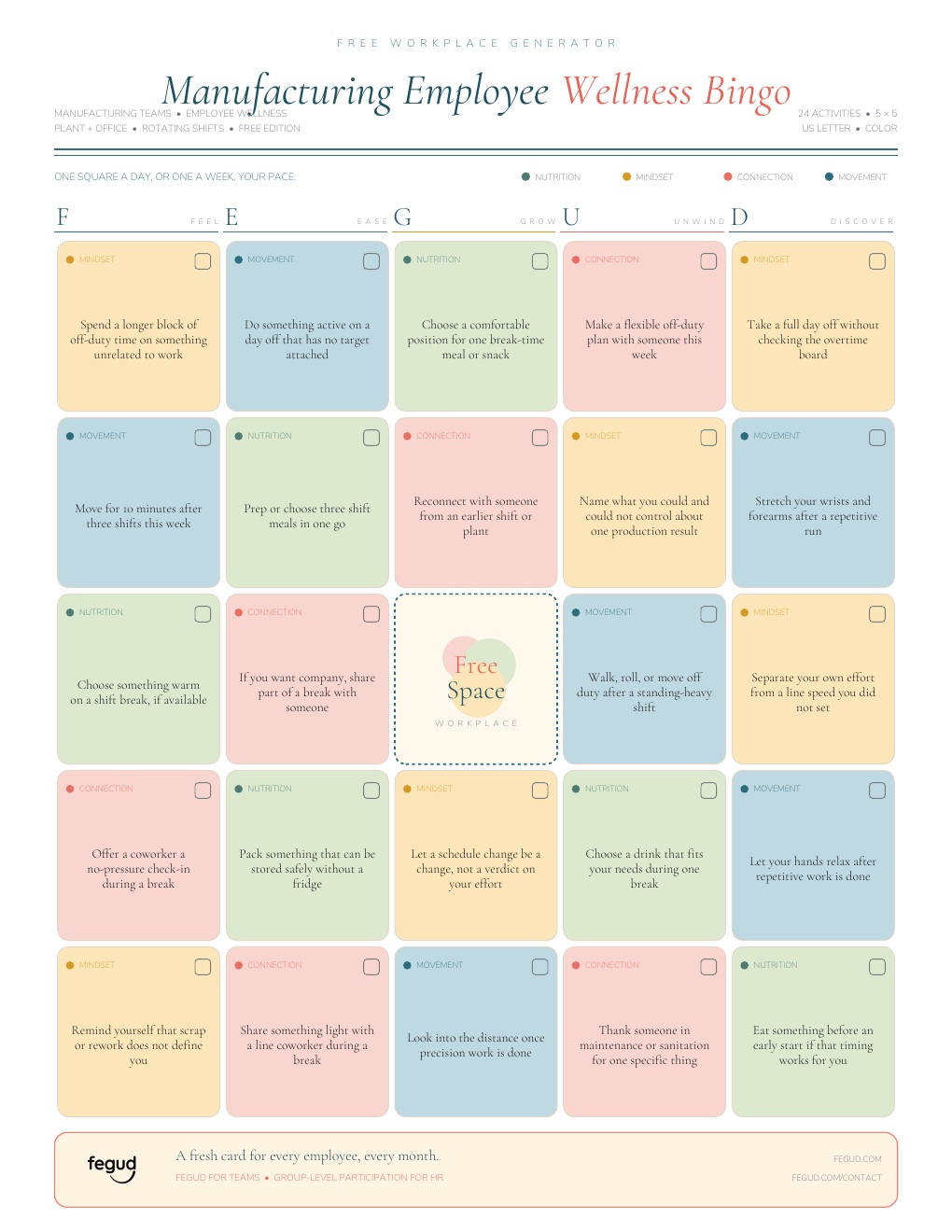
These eight activities come from Fegud’s reviewed Manufacturing Employee Wellness Bingo Card. The wording changes because the work changes. Every activity is voluntary and belongs on personal time or an authorized safe break when the activity permits it. None replaces safe work, required breaks, training, hazard controls, accommodations, or professional care.
Movement
Look into the distance once precision work is done
Precision work can keep attention close for long stretches, so this activity cues a visual reset afterward.
Mindset
Separate your own effort from a line speed you did not set
A production number can reflect staffing, equipment, materials, scheduling, or other system conditions. It should not become a judgment about personal worth.
Mindset
Remind yourself that scrap or rework does not define you
Quality matters. So does separating a process result from a person’s identity.
Movement
Let your hands relax after repetitive work is done
Repetitive hand use is common in many plant roles, making an after-work hand reset specifically relevant.
Nutrition
Pack something that can be stored safely without a fridge
Some employees need food options that fit the storage available to them.
Mindset
Take a full day off without checking the overtime board
A day off can stay separate from work when checking overtime is a choice rather than a requirement.
Connection
Thank someone in maintenance or sanitation for one specific thing
Plants can become siloed by function. A specific thank-you recognizes work that other teams rely on.
Movement
Move for 10 minutes after three shifts this week
This makes the activity distinct from movement that is already part of the job.
Download the free Manufacturing Employee Wellness Bingo card.8 It is one example of Fegud’s activity format, not a complete workplace wellness or safety program.
Why a step challenge can miss the plant floor
Step challenges are easy to explain, but the same target can mean very different things to an assembler, forklift operator, quality technician, engineer, and payroll employee.
Plant and office roles may start with different movement demands. A single step total can reward baseline job movement rather than personal choice. Some challenges also depend on a phone or wearable that may be unavailable, impractical, or prohibited in a controlled area. And a public leaderboard can make wellness feel like another production ranking.
The bigger problem is what happens next. A four-week contest ends. If nothing replaces it, HR is back to launching another one-off campaign from zero.
A recurring program should give employees different ways to participate across Movement, Nutrition, Mindset, and Connection. It should also let someone skip, swap, or privately adapt an activity without having to explain why.
How to evaluate Fegud without risking a plant launch
Fegud is new, and we do not publish participation numbers we cannot show you how we measured. So the evaluation is built so you see the product before anyone in your plant does.
1. Play it yourself
Join the Break Room and get a month of the real monthly card as an HR or People leader, alongside other in-house teams. You learn what your employees would experience before you ask anyone to trust you with it. The Break Room is invite-only and free. Request an invite.
2. See what you would receive
Review the sample report while you play, so you know exactly what HR sees and what stays private. Review the sample report.
3. Test the setup
Start the trial with your own roster, QR enrollment, and languages (14 days for Break Room alumni, 7 days otherwise), and use the setup call to plan a launch that reaches every shift. Start your free trial.
4. Then decide
By this point you have played a full month, read the report, and run your own setup. If Fegud fits your plant and office teams, choose a plan. If it does not, you have lost nothing but a few breaks.
What a recurring program looks like across a year
A recurring program should not need a new internal launch every few months. The delivery repeats, but the employee experience changes.
Month 1
On the first of the month, a new personalized 24-activity card appears in each employee’s app. HR does not have to build a challenge, schedule the card, or prepare another promotional campaign. The employee can start when it fits their schedule and complete activities during personal time or an authorized safe break when the activity permits it.
Month 2
The next card is not the first card with a new date. It draws different activities from Fegud’s library based on the employee’s chosen focus areas and difficulty. Their private adaptations, streaks, and privacy settings carry forward, so they do not have to set up their experience again. They can still skip, swap, or adapt an activity without explaining that choice to HR.14
Month 12
By the end of a year, an employee has received twelve different monthly cards rather than two or three disconnected campaigns. On eligible plans, HR receives an aggregate participation report for each cycle without relaunching the program. The monthly rhythm stays familiar: employees receive a new card, complete what fits, and keep individual activity private. HR receives the program-level view and does not have to re-sell a new contest internally each quarter.13
What the employer still owns
A participation program does not fix unsafe work. It does not replace:
- safe work areas;
- authorized breaks;
- hydration and sanitation access;
- ergonomic and machine-safety controls;
- PPE selection, fit, training, maintenance, and required procedures;
- lockout/tagout and other hazardous-energy controls;
- reasonable accommodation; or
- an EAP, benefits, emergency resources, or appropriate professional support.
OSHA states that employers are responsible for providing a safe and healthful workplace.5 Its PPE guidance also places selection, provision, training, and proper-use responsibilities on the employer.7 OSHA’s noise guidance requires employers to control hazardous exposure and, at covered levels, operate a hearing conservation program.6 These regulatory references are to US OSHA; equivalent employer obligations apply under the laws and regulators of other jurisdictions.
Wellness activities belong around that foundation. They cannot replace it. Any vendor suggesting otherwise is asking employees to carry responsibility that belongs to the organization.
What Fegud adds to a wellness program
Enrollment without a work email
HR can post a QR join code or provide a break-room kiosk link. An employee signs up with an email they can access, requests to join the company, and appears in HR’s approval queue. No invite email or corporate account is required.
English, French, and Spanish
Fegud is available in English, French, and Spanish. That gives teams a practical starting point when more than one language is used on a shift.
Private personalization
Employees can choose seated, low-energy, low-sensory, and low-mobility adaptations. Those choices are not visible to the employer.
Monthly variety
Each employee receives a personalized 24-activity card each month rather than repeating one challenge format indefinitely.
Group-level reporting
HR sees company participation and named department or team patterns for groups of three or more members. Groups smaller than three are combined so no individual can be identified from a group’s numbers. HR does not see an individual’s completed or skipped activities.
Voluntary participation
Employees can skip or change an activity without turning wellness into a test. Participation should never affect attendance, safety scores, performance reviews, discipline, accommodations, or access to required breaks.
How to roll it out across shifts
1. Include every shift
Do not launch at a 10 a.m. office meeting and call the plant covered. Give night, weekend, and rotating-shift employees the same access, explanation, and time to decide.
2. Keep participation voluntary
Make the invitation clear, then leave the choice with the employee. Avoid mandatory photos, public disclosures, weigh-ins, or activities that assume a particular body, diet, family, budget, or home life.
3. Separate wellness from safety compliance
This line should be explicit in the launch message. Wellness completion is not a safety metric. It cannot substitute for training, incident reporting, hazard controls, required PPE, authorized breaks, or medical care. Employees should never complete an activity during machine operation, driving, material handling, lockout, inspection, chemical work, sanitation work, safety steps, or handoffs.
4. Give employees private adaptations
An adaptation is useful only if selecting it does not disclose a personal need to a manager or coworker. Keep that choice inside the employee experience.
5. Measure participation without monitoring individuals
Use company patterns and named department or team patterns for groups of three or more members to understand whether the program is being used. Groups smaller than three are combined so no individual can be identified from a group’s numbers. Do not give managers individual completion histories or a list of who chose which activity.
What HR actually sees
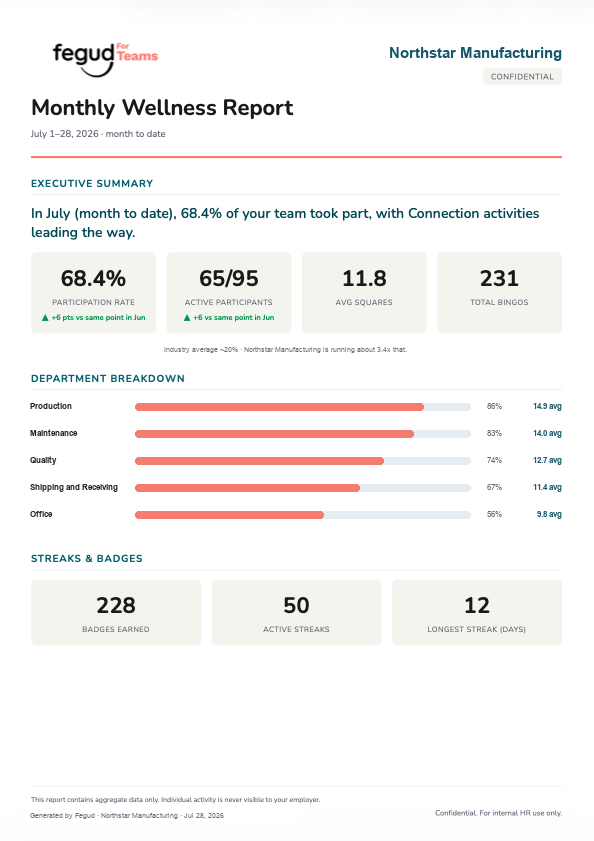
Fegud’s HR report is built around program-level information:
- company participation and active-member totals;
- named department and team patterns for groups of three or more members, with smaller groups combined so no individual can be identified from a group’s numbers;
- focus-area mix, badges, streaks, and bingos; and
- a program-level suggestion for the next month.3
The monthly report does not show employee names, individual activity histories, private answers, notes, or personal wellbeing profiles.3 Company admins can see whether an invited person has joined because they manage invitations and seats. What that person completes, skips, or adapts remains private from the employer.4
Review the sample report or read the Fegud Privacy Promise.
Is Fegud a good fit for your manufacturing company?
Fegud is a strong fit for manufacturers that want one voluntary program for plant and office employees without giving HR access to individual wellness activity. It is especially useful when a company has several shifts, deskless employees, multilingual teams, or a history of short challenges that did not create a recurring program.
Fegud is a good fit when you need
- QR or kiosk enrollment for employees without a work email;
- personalized monthly activities instead of one identical challenge;
- English, French, and Spanish;
- private activity adaptations chosen by the employee;
- aggregate reporting for HR and leadership; and
- a program that stays separate from safety compliance and individual performance.
Fegud is not designed to replace
- an EAP, clinical care, emergency support, or employee benefits;
- occupational health and safety systems;
- required training, hazard controls, ergonomics, PPE, or authorized breaks; or
- an individual employee-monitoring system.
If the goal is voluntary participation across different working conditions while keeping individual activity private, Fegud belongs on the shortlist.
Not sure yet? Play the monthly card yourself first.
The Break Room is a one-month, invite-only season where in-house HR and People leaders use the real monthly card before bringing it to their teams. Request an invite, or take the free Burnout Audit to see where your team is starting from.
Pricing for your team
Fegud prices company plans by employee count in USD:2
Product and pricing details reviewed September 3, 2026.
| Plan | Team size | Annual price | Monthly billing |
|---|---|---|---|
| Starter | Up to 25 employees | $1,990 per year | $199 per month with a 12-month commitment |
| Growth | Up to 100 employees | $4,990 per year | $499 per month with a 12-month commitment |
| Business | Up to 500 employees | $11,990 per year | $1,199 per month with a 12-month commitment |
| Enterprise | 500 or more employees | Custom | Contact Fegud |
Choose the next step by company size
- Fewer than 100 employees: play the Break Room first, then start your free trial to test setup and fit. Starter covers up to 25 employees, while Growth covers up to 100.
- 100 to 500 employees: review the sample report, then book a demo to discuss Business-plan reporting and rollout.
- 500 or more employees: book a demo for Enterprise setup, security review, integrations, and support.
View the sample report | Book a demo | Compare all plans | Start your free trial
Manufacturing wellness program questions
How do employees without a company email address enroll?
HR shares a QR join poster or kiosk link. The employee signs up with an email they can access and submits a request to join the company. HR reviews and approves the request against its roster. No work email or individual invitation email is required.
Does Fegud replace our EAP or safety program?
No. Fegud is a voluntary employee-participation program built around wellness activities. It does not replace an EAP, benefits, accommodations, professional care, safety training, hazard controls, required PPE, authorized breaks, or emergency resources.
What does HR see, exactly?
HR sees company participation and named group patterns for groups of three or more members. Smaller groups are combined. HR does not see which activities an individual completes, skips, or adapts. Company admins can see whether a person has joined because they manage invitations and seats.
How does Fegud work across three shifts?
Each employee uses the app on their own schedule. HR can use QR or kiosk enrollment for employees without a work email, and the monthly card can include activities designed for day, evening, night, weekend, and rotating-shift realities. Activities must happen during personal time or an authorized safe break when the activity permits it.
Is Fegud available in Spanish and French?
Yes. Fegud currently supports English, French, and Spanish. Language availability should be confirmed during setup for any custom company content.
Do we need IT involved?
Not for a standard CSV or individual-invitation setup. SSO, HRIS integration, or a formal security review may require IT participation. SSO and HRIS integration are Enterprise items. Fegud can identify those requirements before launch.
What happens if participation is low?
Start by checking access rather than blaming employees. Review whether every shift received the invitation, whether enrollment works without a corporate login, whether employees understand the privacy boundary, and whether the activities fit their working conditions. Fegud’s group-level reporting can help HR see where participation is lower without exposing individual activity.
Can plant and office employees have different activities?
Yes. Employees receive personalized cards, and private adaptations can change how an activity is completed. Company-level customization depends on the selected plan and agreed setup. Plant and office employees should not be forced into one identical activity mix when their working conditions differ.
Other industries
See the report before you book.
Review the exact group-level information HR receives, then decide whether Fegud fits your teams.
