
Employee wellness for school teams
Wellness Programs for Teachers
A wellness program for teachers has to fit a day shaped by instruction, supervision, student needs, planning, communication, and work that can follow people home. It should also include the non-teaching employees who keep a school running. Fegud adds a voluntary monthly participation layer with private individual activity, but it does not replace staffing, classroom coverage, planning time, duty-free breaks, safe facilities, benefits, accommodations, or professional care.
For HR, People, district, and school leaders supporting teaching and non-teaching employees. Plans cover teams with up to 25 employees through organizations with 500+ employees.
A school day changes the program
Teachers may work in classrooms, labs, gyms, libraries, resource rooms, outdoor spaces, or several of those in one day. The wider school team also includes educational assistants and paraeducators, office staff, custodial and maintenance teams, food-service staff, nurses and counsellors, librarians, transportation staff, substitutes, specialists, and administrators.
One program has to account for:
- instructional blocks, student supervision, traffic duty, meetings, and preparation periods;
- employees whose breaks depend on coverage or shift timing;
- work that involves prolonged standing, sitting, writing, typing, carrying, speaking, or close attention;
- employees without a desk, private office, regular computer access, or work email;
- term openings, reporting periods, events, assessments, and year-end workload; and
- different abilities, languages, energy levels, cultural preferences, and access needs.
The CDC says a school employee wellness program should include every school employee, regardless of role, and recommends staff involvement and administrative support.1 That makes school-wide access part of the program design, not a nice extra.
What teacher-specific activities look like
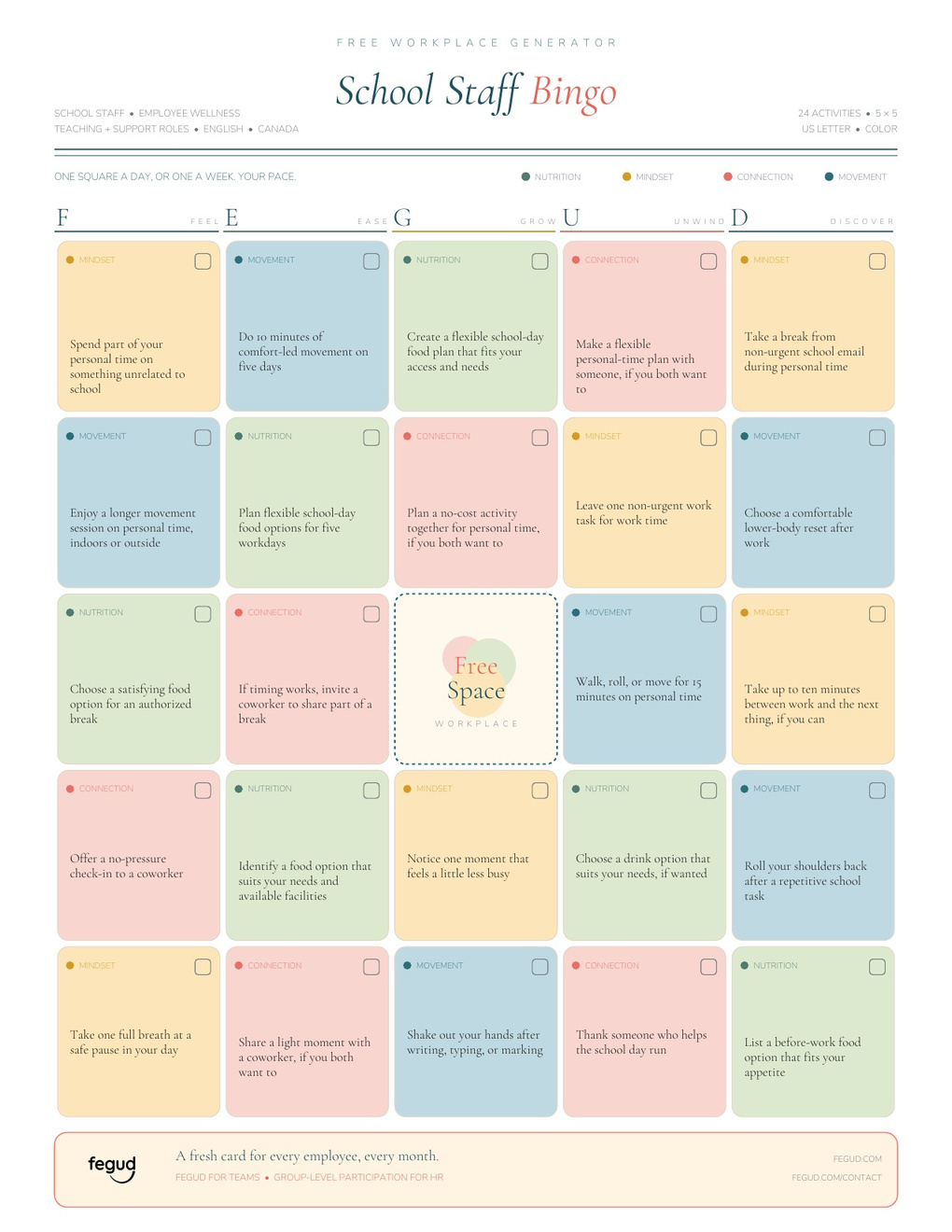
These eight examples come from Fegud’s approved School Staff Wellness Bingo activity pool. They reflect school schedules, repetitive tasks, personal-time boundaries, food access, and the people behind the school day. Every activity is voluntary. Employees can skip it, adapt it privately, or choose something else.
Movement
Shake out your hands after writing, typing, or marking
The timing comes after the repetitive task, not during instruction or supervision.
Movement
Choose a comfortable lower-body reset after work
It separates optional movement from the physical demands already built into the day.
Nutrition
Create a flexible school-day food plan that fits your access and needs
The plan follows the employee’s appetite, culture, budget, storage, schedule, and permitted eating areas.
Nutrition
Choose a satisfying food option for an authorized break
No food rules, weight goals, or assumption that a break room or fridge is available.
Mindset
Leave one non-urgent work task for work time
A small boundary does not pretend to solve an unreasonable workload. It keeps non-urgent work from automatically becoming personal-time work.
Mindset
Take a break from non-urgent school email during personal time
The wording protects urgent or required communication while making room for a real off-duty boundary.
Connection
Thank someone who helps the school day run
A school-wide activity can recognize the work of people who are often missed by teacher-only programs.
Connection
Share a light moment with a coworker, if you both want to
Connection stays optional and does not require personal disclosure, forced socializing, or student involvement.
Build the free School Staff Wellness Bingo card It includes the complete reviewed 24-activity card in US Letter and A4, with color and ink-saving versions.8
Why a step challenge can miss school staff
A teacher, bus driver, office administrator, custodian, educational assistant, and school counsellor can work for the same organization while having very different movement, break, privacy, and technology access. A single step target treats those differences as motivation problems.
It can also reward movement already required by a job, exclude people who move differently, and tempt employees to participate at the wrong time. No activity should compete with instruction, supervision, active driving, food preparation, medication administration, traffic duty, chemical handling, machinery use, or emergency response.
RAND’s 2025 U.S. teacher survey found that teachers worked 49 hours per week on average, ten hours more than their average contracted time, and reported poorer wellbeing than similar working adults across every measure included in the study.2 The U.S. Department of Education’s review also warns that an individual response to structural problems is not a long-term solution.3
The useful role for Fegud is narrower and more honest: give employees a recurring set of choices they can fit around real life, while school and district leaders keep responsibility for the conditions of work.
What a recurring program looks like across a school year
A one-week event creates a burst of attention. A recurring program changes the activities while keeping the participation rhythm familiar.
Opening month
Start with low-pressure activities, explain privacy clearly, and give every role the same invitation without requiring public participation.
Busy reporting period
Prioritize safe pauses, personal-time boundaries, accessible movement, and food options that fit unpredictable timing.
Midyear reset
Refresh the mix across Movement, Nutrition, Mindset, and Connection rather than repeating the same challenge.
High-demand weeks
Use Easy and Balanced options generously. Ambitious should describe a little more planning, not a more intense body demand.
Year end
Protect the difference between work time and personal time without implying that a bingo square can repair workload or staffing.
Between terms
Keep participation optional for employees whose schedules continue, change, or pause. Do not assume everyone follows a teacher calendar.
What the employer still owns
A wellness program cannot make an unsustainable job sustainable by asking employees to cope better. School and district leaders still own:
- staffing, substitute coverage, realistic workloads, protected planning time, and duty-free breaks;
- safe buildings, indoor air quality, violence prevention, infection control, emergency procedures, and role-specific training;
- fair pay, benefits, leave, accommodations, and access to an EAP or professional care;
- clear expectations for email, paperwork, meetings, and work outside contracted time;
- confidential reporting and response processes for harassment, discrimination, safety concerns, and workplace incidents; and
- consultation with employees and their representatives where required.
Statistics Canada’s 2024–2025 working-conditions survey found that management and professional workers were more likely than other groups to face tight deadlines and do unpaid work in their free time. The survey treats working conditions as an employer and system issue, not a personal wellness failure.4
What Fegud adds to a teacher wellness program
Enrollment without a work email
HR can share a QR join code or kiosk link. An employee signs up with an email address they can access, requests to join the organization, and appears in the administrator’s approval queue.
English, Canadian French, and Spanish
Employees choose the available language that works for them. The program can support a multilingual school workforce without making language a separate campaign.
Private personalization
Employees can choose seated, low-energy, low-sensory, and low-mobility adaptations. Those choices are not shown to the employer.
Monthly variety
Each employee receives a personalized 24-activity card each month across Movement, Nutrition, Mindset, and Connection.
Group-level reporting
HR sees program information and eligible group patterns. HR does not receive a private activity history for an individual employee.
Voluntary participation
Employees can skip or change an activity. Participation should never affect performance reviews, attendance, scheduling, discipline, accommodations, benefits, or access to required breaks.
How to roll it out across a school or district
- Map the workforce. Include teaching and non-teaching roles, locations, schedules, languages, break arrangements, and technology access.
- Protect the boundaries. State where participation can happen, where it cannot, and that personal time or an authorized break comes first.
- Use more than email. Pair email with QR posters, staff meetings, break rooms, payroll portals, or other channels employees already use.
- Ask leaders to model, not monitor. A principal or manager can share their own participation without asking who completed a square.
- Keep student and family information out. Activities and team posts should never require a student story, family detail, incident, or health disclosure.
- Review group-level patterns. Use the monthly report to improve access and communication, not to identify individual behaviour.
A simple rollout can start in about 30 minutes. The seven-day trial lets your team test enrollment and the employee experience before making a commitment.
What HR actually sees
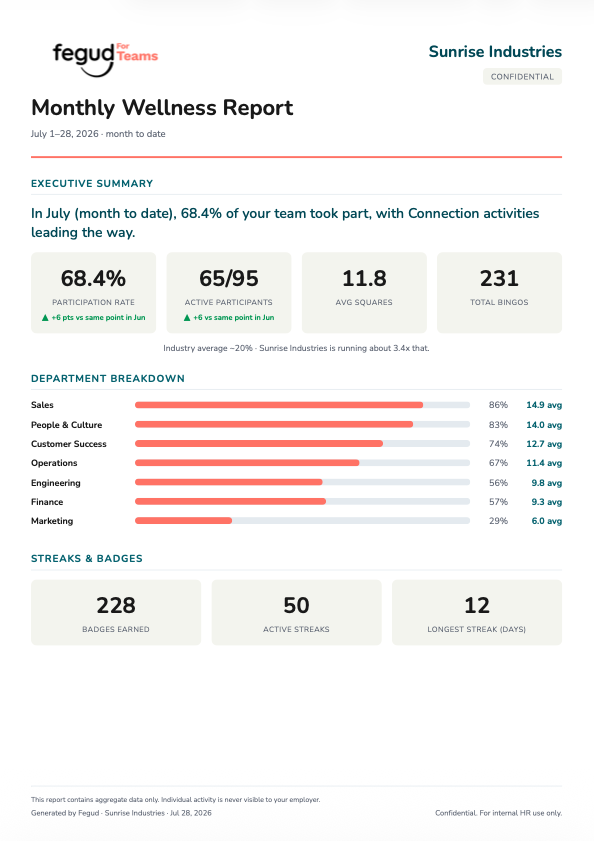
Fegud’s HR report is built around program-level information:
- company participation and active-member totals;
- selected department and team patterns where group-size rules allow;
- focus-area mix, badges, streaks, and bingos; and
- a program-level suggestion for the next month.6
The report does not give administrators a private feed of employee activities completed, skipped, swapped, or adapted, individual points or progress, or individual wellbeing check-in answers and scores.7 Administrators can see whether an invited person has joined because they manage invitations and seats.
Review the sample report or read the Fegud Privacy Promise.
Is Fegud a good fit for your school team?
Fegud is a strong fit for schools and districts that want a recurring, voluntary program for teaching and non-teaching employees without giving administrators access to individual wellness activity.
Fegud is a good fit when you need
- one program that includes teaching and non-teaching roles;
- QR or kiosk enrollment for employees without a work email;
- personalized monthly activities instead of one identical challenge;
- English, Canadian French, and Spanish;
- private activity adaptations chosen by the employee; and
- group-level reporting for HR and leadership.
Fegud is not designed to replace
- staffing, substitute coverage, planning time, duty-free breaks, or safe working conditions;
- an EAP, clinical care, emergency support, or employee benefits;
- required training, accommodations, collective-agreement obligations, or workplace safety systems; or
- an individual employee-monitoring system.
If the goal is to support voluntary participation without turning teacher wellbeing into another assignment, Fegud belongs on the shortlist.
Not sure yet? Try the school staff card first.
Build and print the free School Staff Wellness Bingo card, or take the free Burnout Audit to see where your team is starting.
Pricing for your team
Fegud prices organization plans by employee count in USD.5 Product and pricing details reviewed September 5, 2026.
| Plan | Team size | Annual price | Monthly billing |
|---|---|---|---|
| Starter | Up to 25 employees | $1,990 per year | $199 per month with a 12-month commitment |
| Growth | Up to 100 employees | $4,990 per year | $499 per month with a 12-month commitment |
| Business | Up to 500 employees | $11,990 per year | $1,199 per month with a 12-month commitment |
| Enterprise | 500 or more employees | Custom | Contact Fegud |
Choose the next step by organization size
- Up to 100 employees: use the free card, then start the trial to test setup and fit.
- 100 to 500 employees: review the sample report, then book a demo to discuss Business-plan reporting and rollout.
- 500 or more employees: book a demo for Enterprise setup, security review, integrations, and support.
View the sample report | Book a demo | Compare all plans | Start your free trial
Teacher wellness program questions
What should a wellness program for teachers include?
A useful program should fit the school day rather than asking employees to work around it. It should include voluntary choices across movement, nutrition, mindset, and connection, clear personal-time or authorized-break boundaries, options for different abilities and energy levels, and privacy from individual employer reporting.
Should a teacher wellness program include non-teaching school staff?
Yes. A school runs through teaching and non-teaching roles. Educational assistants, office staff, custodial and maintenance teams, food-service staff, school nurses and counsellors, librarians, transportation staff, substitutes, specialists, and administrators should not be treated as an afterthought.
Can teachers complete Fegud activities during the school day?
Only when an activity fits an authorized break or a genuinely safe pause. Activities should never happen during instruction, student supervision, active driving, food preparation, medication administration, traffic duty, chemical handling, machinery use, or another safety-sensitive responsibility.
Does Fegud replace planning time, classroom coverage, or an EAP?
No. Fegud adds a voluntary participation layer. Schools and districts still own staffing, workload, planning time, duty-free breaks, classroom coverage, safe facilities, benefits, accommodations, violence prevention, and access to professional or emergency support.
Does HR see which activities a teacher completes?
No. Company administrators can manage invitations and seats and review group-level program information. They do not receive an individual feed of activities completed, skipped, changed, or adapted, or individual wellbeing check-in answers and scores.
Can school employees join without a work email?
Yes. HR can share a QR join code or kiosk link. Employees can use an email address they can access and request to join the organization, then HR approves the request.
Is Fegud only for large school districts?
No. Starter covers up to 25 employees, Growth up to 100, Business up to 500, and Enterprise supports organizations with 500 or more employees. A single independent school, a multi-school organization, or a district can choose the tier that fits its eligible team.
Is there a free teacher wellness resource to try first?
Yes. The free School Staff Wellness Bingo Card Generator includes 24 reviewed activities for teaching and non-teaching teams, plus US Letter and A4 formats in color and ink-saving styles. It does not require an account, email address, or credit card.
Other industries
Compare wellness programs for manufacturing companies, or return to the Wellness Programs hub.
Sources
- CDC, Employee Wellness Guide. Updated July 17, 2024. Accessed September 5, 2026.
- RAND, Teacher Well-Being, Pay, and Intentions to Leave in 2025. Published June 24, 2025. Accessed September 5, 2026.
- U.S. Department of Education, Approaches to Teacher Well-Being. August 2024. Accessed September 5, 2026.
- Statistics Canada, Canadian Survey on Working Conditions, 2024–2025. Released January 16, 2026. Accessed September 5, 2026.
- Fegud employee wellness program pricing. Accessed September 5, 2026.
- Fegud sample monthly wellness report. Accessed September 5, 2026.
- Fegud Privacy Promise. Accessed September 5, 2026.
- Fegud Free School Staff Wellness Bingo Card Generator. Accessed September 5, 2026.
See the report before you book.
Review the group-level information HR receives, then decide whether Fegud fits your school team.
