
Construction employee wellness
Wellness Programs for Construction Companies
A construction wellness program should fit changing jobsites, early starts, long commutes, weather, mixed trades, authorized breaks, and safety-sensitive work. It should stay voluntary, work without a corporate email, keep individual activity private from the employer, and sit beside hazard controls, water, rest, sanitation, training, accommodations, benefits, and professional care rather than pretending to replace them.
For HR and People leaders supporting field crews, project teams, supervisors, and office employees, at construction companies of any size, from small teams to 500+ employees.
See it in action
What your team actually sees
A short look at the Fegud employee app: the personalized monthly card, the small activities, and the bingo lines people build over the month.
What employees do in the app is never visible to their employer. HR sees only group totals and averages.
A jobsite changes the program
Wellness programs for construction companies must work around changing sites, early starts, long drives, weather, mixed employers and trades, limited phone access, authorized breaks, and work that is already physically demanding.
Field crews, operators, drivers, supervisors, estimators, project managers, safety staff, and office teams do not share one schedule or one physical baseline. One program has to account for:
- early starts, long commutes, and crews that move between projects;
- work that already involves lifting, climbing, kneeling, vibration, and noise;
- heat, cold, rain, and days lost to weather;
- active work zones where phones and pauses have to wait;
- workers without a desk, regular computer access, or a work email; and
- different abilities, languages, energy levels, and access needs.
Construction worker wellness programs need choices that stay separate from active work and never treat lifting, climbing, tool use, or heat exposure as wellness achievements.
What construction-specific activities look like
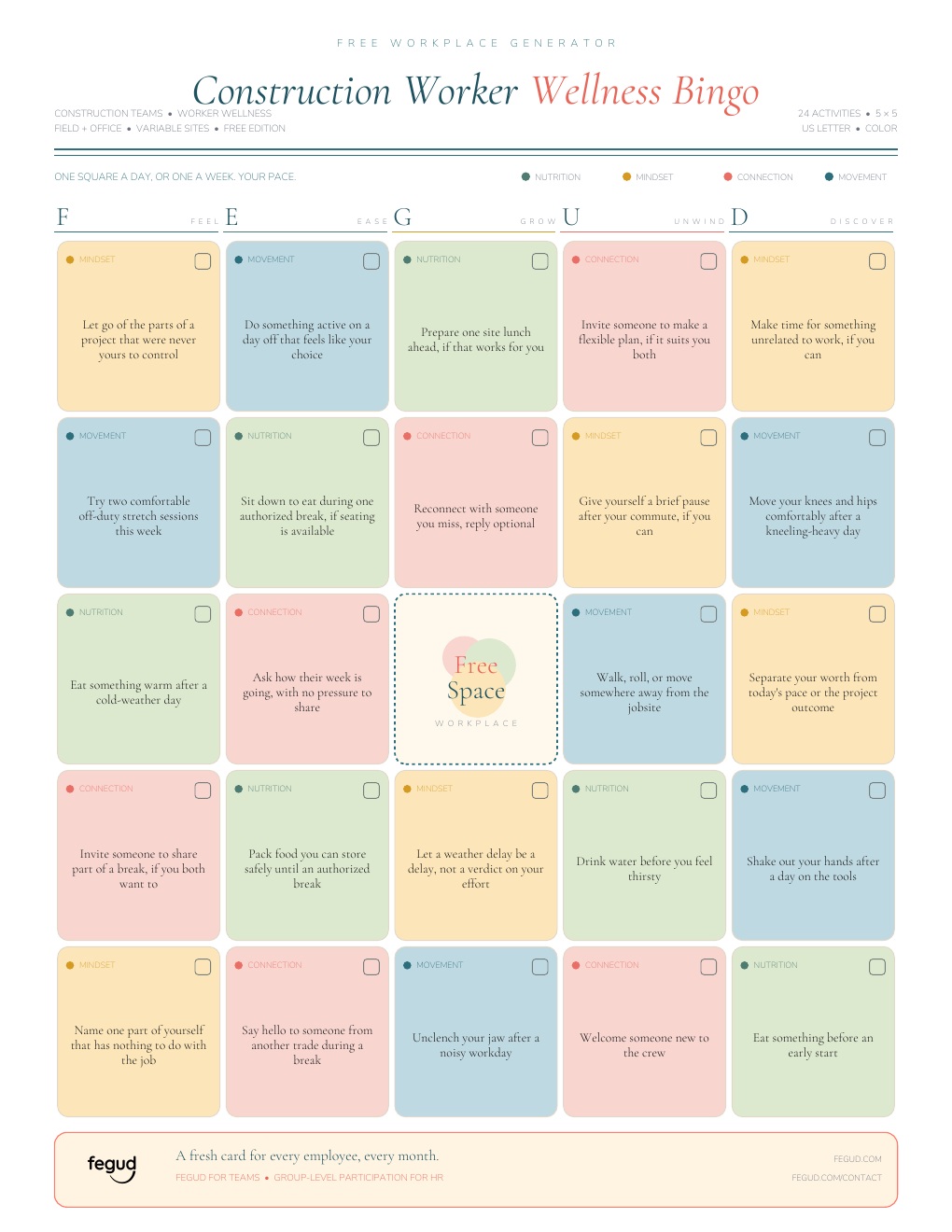
These eight reviewed activities come from Fegud’s approved Construction Worker Wellness Bingo card. They stay outside driving, tool and equipment use, lifting, climbing, traffic control, work at height, hot work, electrical work, and other active duties. Every activity is voluntary. Employees can skip it, adapt it privately, or choose something else.
Movement
Unclench your jaw after a noisy workday
This waits until the shift and active duties are finished. It does not replace noise controls or hearing protection.
Movement
Shake out your hands after a day on the tools
The activity happens after tool use, driving, lifting, and other active duties are finished.
Nutrition
Drink water before you feel thirsty
Water is used only during personal time or a safe pause allowed by site procedures. Water access and heat controls remain employer responsibilities.
Nutrition
Pack food you can store safely until an authorized break
The choice accounts for storage, sanitation, appetite, allergies, culture, budget, and workplace rules.
Mindset
Let a weather delay be a delay, not a verdict on your effort
Weather controls, supervisor direction, schedule updates, and required duties still come first.
Mindset
Give yourself a brief pause after your commute, if you can
The pause starts only after travel is safely complete and stays optional around caregiving, on-call, and other responsibilities.
Connection
Welcome someone new to the crew
A brief welcome can happen during an authorized break or a safe, non-urgent pause away from active duties.
Connection
Invite someone to share part of a break, if you both want to
Either person can decline or choose quiet time. The activity requires a real authorized break away from active work.
Build the free Construction Worker Wellness Bingo card It is a useful example of the activity format, not a complete construction wellness or safety program.6
Why a step challenge can miss construction crews
A single step target compares people whose jobs begin with very different movement demands. A laborer can clear any step goal by mid-morning, while an equipment operator or estimator may spend most of the day seated.
That kind of challenge can reward baseline job movement, exclude employees who use mobility aids, depend on devices that are impractical on site, and make wellness feel like another production ranking.
The bigger problem is what happens next. A four-week contest ends, and HR is back to launching another campaign from zero, across crews spread over several sites.
A better recurring program offers choices across Movement, Nutrition, Mindset, and Connection, protects private adaptations, and leaves safety-sensitive work alone.
What a recurring program looks like across a building season
The card arrives on the first of the month for every worker, on every site. What changes is the weather, the workload, and when people have room to play.
Early starts
Activities wait for an authorized break, the drive home, or personal time. Nothing on the card competes with a 6 a.m. start.
New sites
When a crew moves to a new project, nothing changes in the app. The same card follows each person from site to site.
Weather days
A rained-out day can still count. Mindset and Connection activities do not need a jobsite at all.
Busy season
Long days and tight schedules call for Easy activities and rest days, not a bigger push.
Slow season
When work slows down, the card keeps the rhythm going, so the next busy season does not start with another relaunch.
Month to month
Each month brings a new personalized card, while private adaptations and settings carry forward. HR does not relaunch anything.
What construction employers still own
Fegud does not move employer obligations onto workers. Construction employers still own:
- hazard controls, competent supervision, and training;
- required PPE and authorized breaks;
- potable water, sanitation, and heat and weather plans;
- ergonomic controls for lifting and repetitive work;
- accommodations, benefits, and EAP access; and
- emergency resources and appropriate professional care.
OSHA’s construction guidance covers employer responsibilities across major jobsite hazards.1 Its heat guidance tells employers to provide water, rest, and shade,2 and its ergonomics guidance treats lifting, awkward postures, pushing, pulling, and repetitive work as risks to address through the work system.3 Equivalent obligations apply under the laws and regulators of other jurisdictions.
Wellness activities belong around that foundation. They cannot replace it.
What Fegud adds to a wellness program
Enrollment without a work email
HR can post a QR join code or provide a break-room kiosk link. An employee signs up with an email they can access, requests to join the company, and appears in HR’s approval queue. No invite email or corporate account is required.
English, French, and Spanish
Fegud is available in English, French, and Spanish. Each employee chooses the language that works for them, so a team that works in more than one language does not need a separate campaign.
Private personalization
Employees can choose seated, low-energy, low-sensory, and low-mobility adaptations. Those choices are not visible to the employer.
Monthly variety
Each employee receives a personalized 24-activity card each month across Movement, Nutrition, Mindset, and Connection, rather than repeating one challenge format indefinitely.
Group-level reporting
HR sees company participation and named department or team patterns for groups of three or more members. Groups smaller than three are combined so no individual can be identified from a group’s numbers. HR does not see an individual’s completed or skipped activities.
Voluntary participation
Employees can skip or change an activity without turning wellness into a test. Participation should never affect performance reviews, attendance, scheduling, discipline, accommodations, benefits, or access to required breaks.
How to roll out a construction employee wellness program
- Include field and office teams. Name projects, yards, shops, shifts, and office groups in the launch plan.
- Keep participation voluntary. Do not connect completion to attendance, safety scores, project reviews, performance, or discipline.
- Separate wellness from active work. Activities wait for personal time, an authorized break, or a safe non-urgent pause when the activity permits it.
- Give employees private choices. Let people select focus areas, difficulty, and adaptations without reporting those choices to HR or supervisors.
- Measure the program without monitoring individuals. Use company and eligible group patterns, not personal activity history.
A simple rollout can start in about 30 minutes. A QR poster in the site trailer or yard reaches crews who never see a work inbox, and the trial lets your team test it before making a commitment.
What HR actually sees
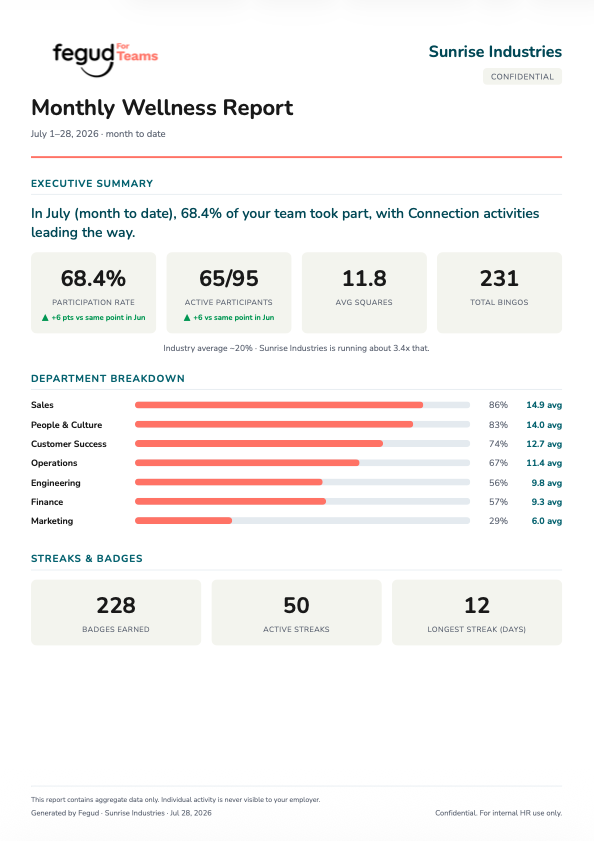
Fegud’s HR report is built around program-level information:
- company participation and active-member totals;
- named department and team patterns for groups of three or more members, with smaller groups combined so no individual can be identified from a group’s numbers;
- focus-area mix, badges, streaks, and bingos; and
- a program-level suggestion for the next month.4
The monthly report does not show employee names, individual activity histories, private answers, notes, or personal wellbeing profiles.4 Company admins can see whether an invited person has joined because they manage invitations and seats. What that person completes, skips, or adapts remains private from the employer.5
Review the sample report or read the Fegud Privacy Promise.
Is Fegud a good fit for your construction company?
Fegud is a strong fit for construction companies that want one recurring, voluntary program for field and office teams without giving HR access to individual wellness activity. It is especially useful when crews move between sites, rarely see a desk, or work in more than one language.
Fegud is a good fit when you need
- one program for field crews, project teams, and office staff;
- activities that wait for a safe time;
- QR or kiosk enrollment for employees without a work email;
- English, French, and Spanish;
- private activity adaptations chosen by the employee; and
- group-level reporting that does not expose individuals.
Fegud is not designed to replace
- hazard controls, safety training, or required PPE;
- water, rest, shade, sanitation, or authorized breaks;
- an EAP, clinical care, benefits, or accommodations;
- staffing and scheduling decisions; or
- an individual employee-monitoring system.
If the goal is voluntary participation across every site while keeping individual activity private, Fegud belongs on the shortlist.
How to evaluate Fegud before you commit
Fegud is new, and we do not publish participation numbers we cannot show you how we measured. So the evaluation is built so you see the product before anyone on your team does. Each step answers a different question, and you can stop at any of them.
Step 1
Play the card yourself
Join The Break Room, a free, invite-only monthly season for HR and People leaders, and play the real monthly card before you ask anyone else to.
Step 2
Read the sample report
See exactly what HR receives each month, and what it leaves out by design.
Step 3
Try it with your team
Test your roster, QR enrollment, and languages with real people for 7 days. No credit card.
Step 4
Decide
By now you have played the card, read the report, and run your own setup. Choose a plan only if Fegud fits. Plans are priced by employee count in USD.
Not ready to run a program yet? Take the free Burnout Audit to see where your team is starting.
Pricing for your team
Fegud prices plans by employee count in USD. Product and pricing details reviewed September 29, 2026.
| Plan | Team size | Annual price | Monthly billing |
|---|---|---|---|
| Starter | Up to 25 employees | $1,990 per year | $199 per month with a 12-month commitment |
| Growth | Up to 100 employees | $6,990 per year | $699 per month with a 12-month commitment |
| Business | Up to 250 employees | $14,990 per year | $1,499 per month with a 12-month commitment |
| Business Plus | Up to 500 employees | $24,990 per year | $2,499 per month with a 12-month commitment |
| Enterprise | 501 or more employees | Custom | Contact Fegud |
Choose the next step by company size
- Up to 100 employees: play the monthly card in the Break Room first, then start your free trial to test setup and fit.
- Up to 250 employees: review the sample report, then book a demo to discuss Business-plan reporting and rollout.
- Up to 500 employees: review the sample report, then book a demo to discuss Business Plus reporting and rollout.
- 501 or more employees: book a demo for Enterprise setup, security review, integrations, and support.
View the sample report | Book a demo | Compare all plans | Start your free trial
Construction wellness program questions
How can construction crews join without a work email?
HR can share a QR join poster or kiosk link. A worker signs up with an email they can access, requests to join the company, and HR approves the request against the roster. A work email is not required.
Does Fegud replace a construction safety program or EAP?
No. Fegud is a voluntary employee participation program. It does not replace hazard controls, training, required PPE, authorized breaks, water and sanitation, accommodations, benefits, an EAP, emergency resources, or professional care.
What does HR see about construction employees?
HR sees company participation and named department or team patterns only for groups of three or more members. Smaller groups are combined. HR does not see an individual employee’s completed or skipped activities, private adaptations, notes, or personal wellbeing answers.
How does the program work across changing jobsites and shifts?
A company can include field and office teams in one monthly program. Employees complete activities when they fit their own schedule and receive a fresh personalized card each month without a separate relaunch for every project or site.
Can field crews and office teams receive different activities?
Yes. Employees choose focus areas, difficulty, and private adaptations. The program can fit trades, operators, drivers, supervisors, estimators, project staff, and office teams without turning job duties into wellness activities.
Is Fegud available in more than one language?
Yes. Fegud is available in English, French, and Spanish. Language access helps a construction company offer one program across crews without assuming every employee uses English at work.
Is Fegud a good fit for a construction company?
Fegud is a good fit when a construction company wants a recurring voluntary program with short activities, deskless enrollment, private personalization, multiple languages, and group-level reporting. It is not a safety-management system, clinical service, staffing solution, or individual-monitoring tool.
Other industries
Fegud shapes the monthly card for each kind of workplace. Browse wellness programs by industry.
Sources
- OSHA, Construction Industry. Accessed October 2, 2026.
- OSHA, Water. Rest. Shade.. Accessed October 2, 2026.
- OSHA, Ergonomics. Accessed October 2, 2026.
- Fegud sample monthly wellness report.
- Fegud Privacy Promise.
- Fegud Free Construction Worker Wellness Bingo Card Generator.
- Fegud for Teams.
- Fegud employee wellness program pricing.
See the report before you book.
Review the exact group-level information HR receives, then decide whether Fegud fits your teams.
