
Warehouse employee wellness
Employee Wellness Programs for Warehouse Teams
A warehouse employee wellness program should fit variable shifts, repetitive work, cold storage, equipment zones, rate pressure, and limited access to desks or work email. It should stay voluntary, protect individual activity privacy, and never replace safe staffing, breaks, training, ergonomics, accommodations, benefits, or professional care.
For HR, safety, operations, and People leaders supporting receiving, putaway, picking, packing, shipping, loading, inventory, maintenance, quality, and office teams, at sites of any size, from small teams to 500+ employees.
See it in action
What your team actually sees
A short look at the Fegud employee app: the personalized monthly card, the small activities, and the bingo lines people build over the month.
What employees do in the app is never visible to their employer. HR sees only group totals and averages.
A warehouse shift changes the program
Warehouse employee wellness programs must work around variable shifts, repetitive tasks, equipment zones, cold storage, rate pressure, and real break access.
Receiving, putaway, picking, packing, shipping, loading, inventory, maintenance, quality, safety, supervisors, and office teams can share one building and almost nothing else. One program has to account for:
- day, night, weekend, and rotating shifts, plus seasonal and temporary staff;
- repetitive lifting, reaching, walking, and picking that already fill the shift;
- forklifts, conveyors, powered equipment, and cold storage, where phones and pauses have to wait;
- rates and targets the employee did not set;
- employees without a desk, regular computer access, or a work email; and
- different abilities, languages, energy levels, and access needs.
A useful program never treats work output as wellness participation.
What warehouse-specific activities look like
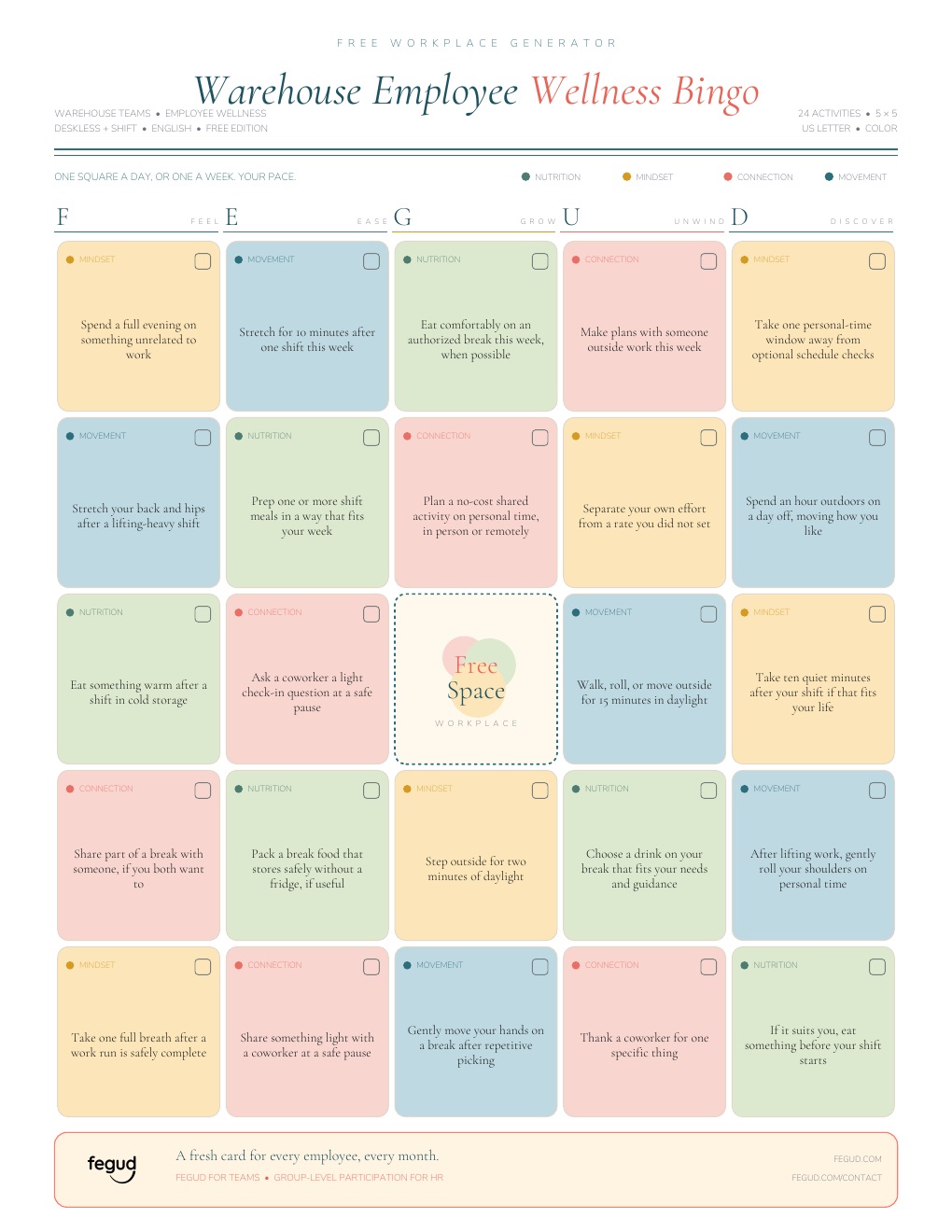
These eight activities appear on Fegud’s warehouse employee wellness card. Each one uses personal time, an authorized break, or a safe pause after active work and equipment movement are complete. Every activity is voluntary. Employees can skip it, adapt it privately, or choose something else.
Movement
After lifting work, gently roll your shoulders on personal time
Once the shift and lifting work are finished, use a comfortable range. Sit, use support, stop, or skip it if that fits better.
Movement
Gently move your hands on a break after repetitive picking
Use an authorized break away from tools, conveyors, vehicles, and powered equipment. Resting your hands is also a valid choice.
Nutrition
Choose a drink on your break that fits your needs and guidance
Use a permitted break area. Follow your fluid needs and personal guidance, and skip it when drinking is not right for you.
Nutrition
Pack a break food that stores safely without a fridge, if useful
Plan off duty around appetite, budget, allergies, culture, storage, and workplace food rules. A ready-made option or no packed food is fine.
Mindset
Take one full breath after a work run is safely complete
Use a safe pause only after equipment movement and the active task are complete. Required duties and safety procedures come first.
Mindset
Separate your own effort from a rate you did not set
Private reflection does not fix employer-set rates, monitoring, staffing, or workload. Skip it if the activity is not useful.
Connection
Thank a coworker for one specific thing
Use a safe pause. Keep it brief, voluntary, and private, with no reply or personal disclosure required.
Connection
Share part of a break with someone, if you both want to
This works only when authorized breaks overlap. Solitude is equally valid, and either person can decline or change plans.
Build the free Warehouse Employee Wellness Bingo card It is a useful example of the activity format, not a complete warehouse wellness or safety program.5
Why a step challenge can miss warehouse teams
One step target compares roles with different walking, lifting, seated work, devices, abilities, schedules, and access to safe routes. A picker can pass any step goal before lunch, while a forklift operator or inventory clerk may barely register.
That kind of challenge can reward job movement, exclude people who use mobility aids, and pressure a tired employee to add activity when rest is the better choice. A public leaderboard can also start to feel like one more rate.
The bigger problem is what happens next. A four-week contest ends, and HR is back to launching another campaign from zero, across every shift again.
A better recurring program offers private choices across Movement, Nutrition, Mindset, and Connection, and keeps wellness separate from output.
What a recurring program looks like across a warehouse year
The card arrives on the first of the month for everyone, whatever the season. What changes is how much room people have to play it.
New hires
Seasonal and new employees join with the QR code and get the same monthly card on their first day. No separate onboarding campaign is needed.
Steady weeks
Activities fit authorized breaks and personal time on any shift, in any order across the month.
Peak season
When volume spikes, Easy activities and rest days keep the program from becoming one more thing to keep up with.
After peak
A fresh card arrives on the first of the month. Nobody has to catch up on what they skipped.
Nights and weekends
Every shift gets the same card and the same invitation, not a leftover version of a daytime launch.
Month to month
Each month brings a new personalized card, while private adaptations and settings carry forward. HR does not relaunch anything.
What warehouse employers still own
Wellness never transfers employer responsibilities to employees. Employers still own:
- hazard controls, equipment maintenance, and training;
- safe staffing and realistic rates;
- ergonomics and material-handling controls;
- required breaks, sanitation, and heat and cold protections;
- reasonable accommodations, benefits, and EAP access; and
- emergency support and appropriate professional care.
OSHA identifies forklifts, ergonomics, material handling, hazardous chemicals, slips and falls, and robotics among common warehousing safety topics.12 Equivalent obligations apply under the laws and regulators of other jurisdictions.
Wellness activities belong around that foundation. They cannot replace it.
What Fegud adds to a wellness program
Enrollment without a work email
HR can post a QR join code or provide a break-room kiosk link. An employee signs up with an email they can access, requests to join the company, and appears in HR’s approval queue. No invite email or corporate account is required.
English, French, and Spanish
Fegud is available in English, French, and Spanish. Each employee chooses the language that works for them, so a team that works in more than one language does not need a separate campaign.
Private personalization
Employees can choose seated, low-energy, low-sensory, and low-mobility adaptations. Those choices are not visible to the employer.
Monthly variety
Each employee receives a personalized 24-activity card each month across Movement, Nutrition, Mindset, and Connection, rather than repeating one challenge format indefinitely.
Group-level reporting
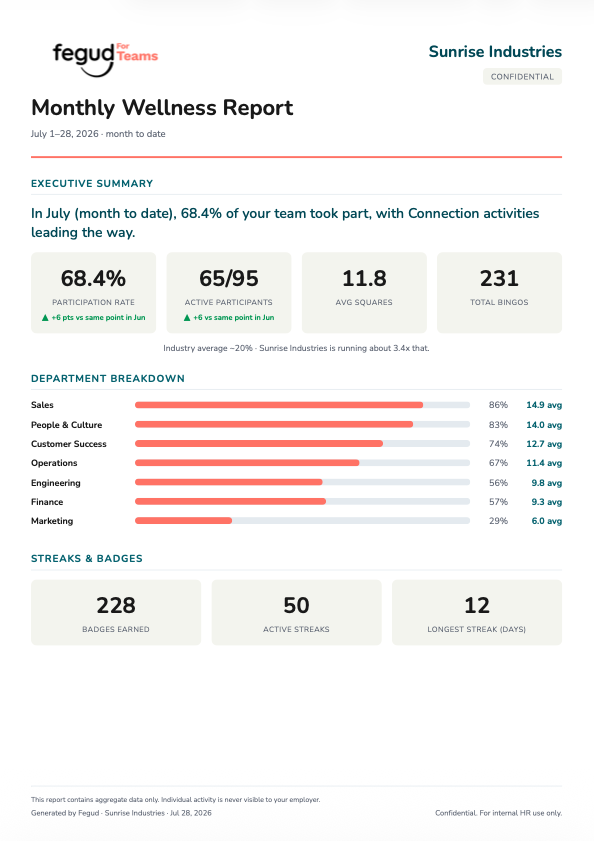
HR sees company participation and named department or team patterns for groups of three or more members. Groups smaller than three are combined so no individual can be identified from a group’s numbers. HR does not see an individual’s completed or skipped activities.
Voluntary participation
Employees can skip or change an activity without turning wellness into a test. Participation should never affect performance reviews, attendance, scheduling, discipline, accommodations, benefits, or access to required breaks.
How to roll it out across a warehouse or distribution center
- Map the workforce. Include shifts, roles, sites, languages, break access, kiosk access, and employees without a work email.
- Set the safety boundary. Activities happen only on personal time, authorized breaks, or after active work and equipment movement are safely complete.
- Open deskless enrollment. Post the QR join code in approved areas and provide a kiosk option.
- Launch one monthly card. Explain voluntary choice, private adaptations, and what managers can and cannot see.
- Review group patterns. Use eligible group-level reporting to adjust communication and access, not to rank people or shifts.
A simple rollout can start in about 30 minutes. The trial lets your team test enrollment and the employee experience before making a commitment.
What HR actually sees
Fegud’s HR report is built around program-level information:
- company participation and active-member totals;
- named department and team patterns for groups of three or more members, with smaller groups combined so no individual can be identified from a group’s numbers;
- focus-area mix, badges, streaks, and bingos; and
- a program-level suggestion for the next month.3
The monthly report does not show employee names, individual activity histories, private answers, notes, or personal wellbeing profiles.3 Fegud does not connect to scan-rate or productivity systems, so wellness activity never mixes with rate data. Company admins can see whether an invited person has joined because they manage invitations and seats. What that person completes, skips, or adapts remains private from the employer.4
Review the sample report or read the Fegud Privacy Promise.
Is Fegud a good fit for your warehouse?
Fegud is a strong fit for warehouses and distribution centers that want one recurring, voluntary program across every shift without giving HR access to individual wellness activity. It is especially useful when a site runs several shifts, hires seasonally, or works in more than one language.
Fegud is a good fit when you need
- one program across shifts, sites, and deskless roles;
- QR or kiosk enrollment for employees without a work email;
- personalized monthly activities instead of one annual challenge;
- English, French, and Spanish;
- private activity adaptations chosen by the employee; and
- group-level reporting that stays separate from rates and productivity.
Fegud is not designed to replace
- warehouse safety management or incident reporting;
- breaks, staffing, training, benefits, or accommodations;
- an EAP, clinical care, or emergency support; or
- productivity, scan-rate, location, or individual employee monitoring.
If the goal is voluntary participation across every shift while keeping individual activity private, Fegud belongs on the shortlist.
How to evaluate Fegud before you commit
Fegud is new, and we do not publish participation numbers we cannot show you how we measured. So the evaluation is built so you see the product before anyone on your team does. Each step answers a different question, and you can stop at any of them.
Step 1
Play the card yourself
Join The Break Room, a free, invite-only monthly season for HR and People leaders, and play the real monthly card before you ask anyone else to.
Step 2
Read the sample report
See exactly what HR receives each month, and what it leaves out by design.
Step 3
Try it with your team
Test your roster, QR enrollment, and languages with real people for 7 days. No credit card.
Step 4
Decide
By now you have played the card, read the report, and run your own setup. Choose a plan only if Fegud fits. Plans are priced by employee count in USD.
Not ready to run a program yet? Take the free Burnout Audit to see where your team is starting.
Pricing for your team
Fegud prices plans by employee count in USD. Product and pricing details reviewed September 29, 2026.
| Plan | Team size | Annual price | Monthly billing |
|---|---|---|---|
| Starter | Up to 25 employees | $1,990 per year | $199 per month with a 12-month commitment |
| Growth | Up to 100 employees | $6,990 per year | $699 per month with a 12-month commitment |
| Business | Up to 250 employees | $14,990 per year | $1,499 per month with a 12-month commitment |
| Business Plus | Up to 500 employees | $24,990 per year | $2,499 per month with a 12-month commitment |
| Enterprise | 501 or more employees | Custom | Contact Fegud |
Choose the next step by company size
- Up to 100 employees: play the monthly card in the Break Room first, then start your free trial to test setup and fit.
- Up to 250 employees: review the sample report, then book a demo to discuss Business-plan reporting and rollout.
- Up to 500 employees: review the sample report, then book a demo to discuss Business Plus reporting and rollout.
- 501 or more employees: book a demo for Enterprise setup, security review, integrations, and support.
View the sample report | Book a demo | Compare all plans | Start your free trial
Warehouse employee wellness program questions
Can warehouse employees complete activities during active work?
No. Activities happen on personal time, during a real authorized break, or after an active task and equipment movement are safely complete. They do not happen during lifting, picking, packing, loading, driving, powered-equipment use, conveyor work, cold-storage duty, maintenance, chemical handling, or another safety-sensitive task.
Does Fegud replace warehouse safety or ergonomics programs?
No. Fegud is a voluntary employee participation program. It does not replace hazard controls, safe staffing, training, ergonomics, equipment maintenance, sanitation, required breaks, accommodations, benefits, emergency support, or professional care.
What does HR see about participating warehouse employees?
HR sees company participation and named department or team patterns only for groups of three or more members. Smaller groups are combined. HR does not see an individual employee’s completed or skipped activities, private adaptations, notes, or personal wellbeing answers.
How can one program fit receiving, picking, packing, and shipping teams?
Employees choose short activities that fit their own schedule, role, abilities, and safe break access. Receiving, putaway, picking, packing, shipping, loading, inventory, maintenance, quality, safety, and office teams can join one program without sharing one work pattern.
Can warehouse teams join without a work email?
Yes. HR can post a QR join code or provide a kiosk link. Employees use an email they can access, request to join the company, and appear in the HR approval queue.
Is Fegud available in more than one language?
Yes. Fegud is available in English, French, and Spanish.
Is Fegud a good fit for a warehouse or distribution center?
Fegud fits warehouses and distribution centers that want recurring voluntary activities, deskless enrollment, private personalization, several languages, and group-level reporting. It is not a safety system, productivity tracker, clinical service, or individual-monitoring product.
Other industries
Fegud shapes the monthly card for each kind of workplace. Browse wellness programs by industry.
Sources
- OSHA, Warehousing Hazards and Solutions. Accessed October 9, 2026.
- OSHA, Warehousing Industry Employment publication. Accessed October 9, 2026.
- Fegud sample monthly wellness report.
- Fegud Privacy Promise.
- Fegud Free Warehouse Employee Wellness Bingo Card Generator.
- Fegud for Teams.
- Fegud employee wellness program pricing.
See the report before you book.
Review the exact group-level information HR receives, then decide whether Fegud fits your teams.
