Your next break does not need a whole plan.
Self-care activities at work can be as simple as looking away from a screen, changing position, getting a drink, stepping outside, or sending a quick hello. Choose one thing that fits the break and setting you actually have. No special equipment, personal disclosure, or company program required.
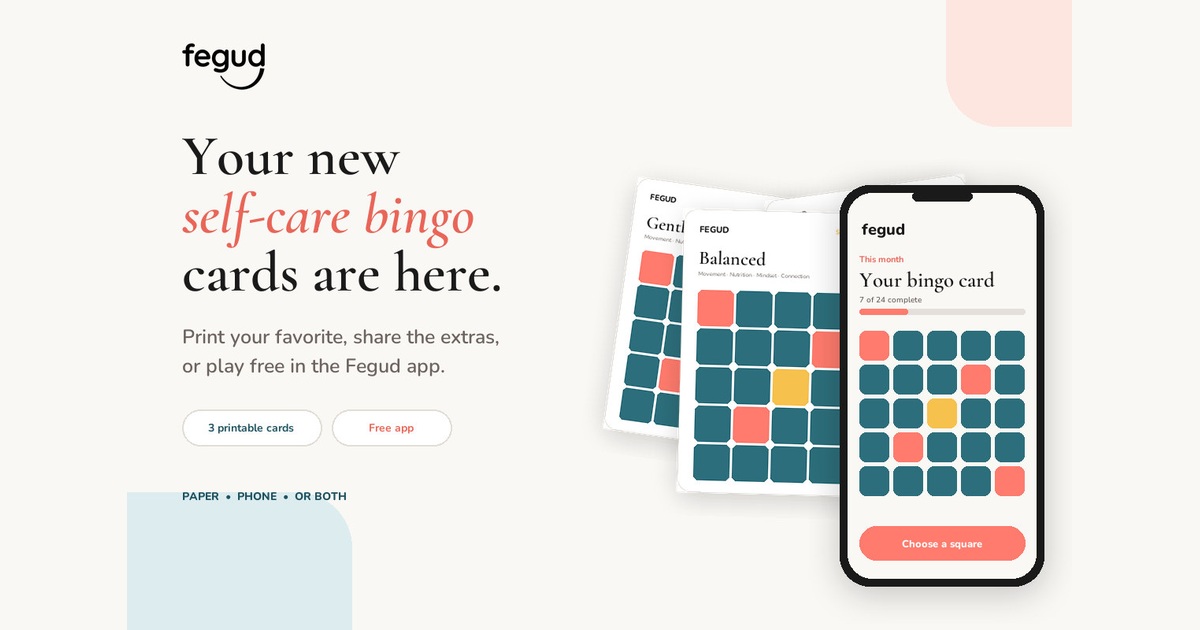
To begin, pair these self-care activities at work with Fegud’s free printable self-care bingo card, or choose a digital card in the iOS app or Android app.
self-care activities at work: Quick answer: seven activities for your next break
Need an idea now? Pick one:
- Look at something farther away than your screen for one minute.
- Change position in a way that feels comfortable.
- Get a glass of water or refill the bottle you already use.
- Step outside, move near a window, or notice the weather from where you are.
- Put your phone down and listen to one familiar song.
- Send a light message to someone you trust.
- Write down the next small work step, then leave it until your break ends.
That is the whole activity. You do not have to complete all seven, track a streak, or make your break productive.
self-care activities at work: What quiet and seated activities can you do at work?
Some breaks need to be discreet. Maybe you share a workspace, cannot leave your station, or simply do not want more conversation. These choices can stay quiet.
self-care activities at work: Rest your attention somewhere else
Choose a window, picture, plant, wall, or distant point in the room. Look there for a minute instead of switching from a work screen to a phone screen. You do not need to meditate or clear your mind. You are just giving your attention a different job.
self-care activities at work: Make one small comfort adjustment
Move a bag out of the way. Adjust the lighting if you control it. Put water within reach. Change the volume on your headphones. Fix one ordinary annoyance that can be changed without turning your break into a desk makeover.
self-care activities at work: Read something unrelated to work
Read two pages of a book, one saved article, or a short comic. Choose something with a clear stopping point. The goal is not to finish a chapter before your next meeting.
self-care activities at work: Write a three-line offload
On paper or in a private note, write:
- What is still on my mind?
- What is the next visible step?
- What can wait?
Keep it practical. You do not have to record personal feelings or share the note with anyone.
self-care activities at work: Which standing and screen-free activities fit a break?
A screen-free break can happen without a walk, workout, or change of clothes.
self-care activities at work: Change position
Stand if you have been sitting. Sit if you have been standing. Stretch your hands, roll your shoulders, or shift your weight in a way that is comfortable for you. If changing position is not available, try a smaller adjustment where you are.
self-care activities at work: Take the short route on purpose
Walk to refill water, visit the washroom, check the mail area, or take a lap through an appropriate part of your worksite. There is no distance target. The CDC notes that some physical activity is better than none, so a short bit of movement can stay short.
self-care activities at work: Do one ordinary task without a screen
Make tea, wipe your glasses, water a plant you already care for, or organize five physical items. Pick the finish line before you start. Five items means five, not an accidental filing project.
self-care activities at work: Notice the setting
For another choice midway through, pair these self-care activities at work with Fegud’s free printable self-care bingo card, or choose a digital card in the iOS app or Android app.
If you can go outside, notice the temperature, light, or one sound before heading back. If you cannot leave, use a window, doorway, break room, vehicle, or quieter corner that is available and appropriate for your setting.
self-care activities at work: What social activities work without personal disclosure?
Social self-care at work does not require a heart-to-heart. It can be brief, ordinary, and easy to decline.
Send a low-pressure message
Try “Want to grab water?” or “I am taking five minutes outside if you want to join.” Make the invitation specific and optional. If nobody joins, the break still works.
Ask an everyday question
Ask about a lunch spot, a song, a show, a recipe, or a practical work tip. Choose a topic that does not ask someone to explain their health, family, or private life.
Share quiet company
Sit near someone during lunch, walk the same route, or take separate breaks in the same space. You can be around another person without carrying the conversation.
And if you need less interaction, mute nonessential notifications for the length of your break. Quiet is a valid choice too.
What works for office, remote, deskless, freelance, and hybrid work?
The setting changes the menu. It does not cancel the break.
| Work setting | One practical activity |
|---|---|
| Office | Leave the screen behind and refill your water |
| Remote | Step into another room or sit by a window for one song |
| Deskless | Change position, get water, or take a quiet pause in an appropriate break area |
| Freelance | Set a clear ten-minute stop between tasks and go outside or make a drink |
| Hybrid | Keep one simple activity that works in both locations, such as a screen-free lunch start |
| Between locations | Sit somewhere safe and stationary, notice your surroundings, or send a short hello before moving on |
Choose options that fit your duties, break rules, access needs, location, and safety requirements. If one suggestion does not fit, skip it. The list is a menu, not a standard you have to meet.
How do you choose by break length and setting?
Start with the time you truly have:
- One minute: Look away from the screen, change position, or take a drink.
- Five minutes: Listen to one song, step outside, or write a three-line offload.
- Ten minutes: Walk a short route, read two pages, or sit somewhere different.
- A meal break: Put the screen away for the first few bites, eat somewhere else if available, or invite someone to join without making it a work meeting.
Then check the setting. Do you need quiet? Can you move? Are you indoors or outdoors? Do you want company or less input? Pick the first activity that fits instead of searching for the perfect one.
If duration is your main filter, use Fegud’s separate list of 5-minute self-care activities. If you want an ongoing structure, the guide to build a self-care routine owns that job. This page stays focused on the workday in front of you.
What if the problem is the work itself?
A small activity can give you something manageable to do during a break. It cannot fix an unsafe task, unmanageable workload, missing break coverage, poor treatment, or a schedule that leaves no room to pause.
The Canadian Centre for Occupational Health and Safety lists long work hours, insufficient break time between shifts, workload, task timing, and workplace conditions among factors that can contribute to fatigue. Its guidance also points workplaces toward measures such as assessing job demands and reviewing schedules and tasks. Read the full CCOHS workplace fatigue guidance for that broader context.
If the concern is structural, name the actual issue through the appropriate workplace channel available to you. Do not make yourself responsible for solving it with a better water bottle or a more disciplined break.
For an ordinary workday break, keep the choice small. Try one activity, let the break be a break, and return when it is over.
Want more choices for outside the workday too? Get Fegud’s free self-care bingo card and choose one square when it suits you.
When you want a next step, pair these self-care activities at work with Fegud’s free printable self-care bingo card, or choose a digital card in the iOS app or Android app.
No performance points. Just one square, one break, or one quiet minute that belongs to you.