A paper bingo card for self-care and a wellness app do not have to compete. Paper gives you a card you can leave in sight and mark by hand. An app is easier to carry, update, and use with friends. The better format is the one you will notice and enjoy using.
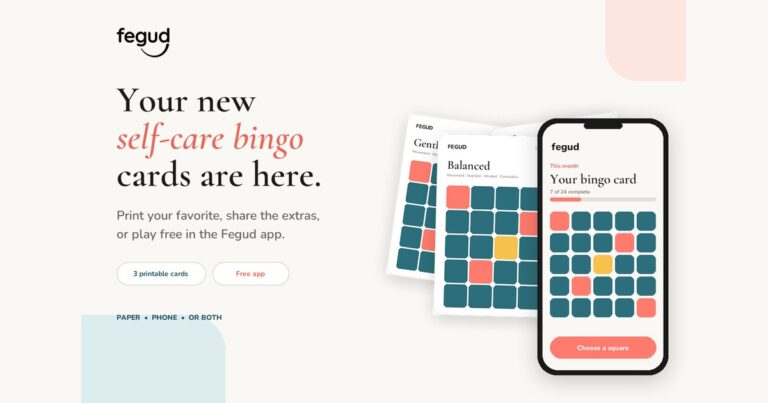
Fegud offers both. You can get three free printable self-care bingo cards each month, use the free personal mode in the Fegud app, or use paper and the app together.
A paper bingo card for self-care is most useful when its location and format suit the person using it.
Quick answer: Can a paper bingo card for self-care be better than an app?
A paper card can be better if you want an offline activity tracker that stays visible, feels satisfying to mark, and does not depend on opening another app. An app can be better for portable access and shared play. For many people, printing the card and keeping the app available offers the most flexible setup.
Choose a paper bingo card for self-care for visibility, not because paper promises a stronger brain effect.
What Happens in Your Brain When You Write Something Down
Writing by hand is a real sensory and motor activity, but it is easy to stretch that fact into claims the research does not support.
In one study of 48 university students, people recorded schedule information in a paper notebook, on a tablet with a stylus, or on a smartphone. The paper group recorded the information faster, answered the easier memory questions more accurately, and showed stronger activation in several regions during later retrieval. The researchers suggested that the fixed spatial and tactile information on paper may have provided useful retrieval cues. That was a specific note-taking task, not a test of self-care, bingo, or long-term habits. Read the paper-notebook and mobile-device study.
A separate study of 33 adults learning unfamiliar words found EEG differences after handwriting compared with typing, but its behavioural measures did not differ by writing tool. The authors also found that familiarity with a digital pen mattered. Read the handwriting, typing, and word-learning study.
The wider evidence is not one-sided. A study of 68 medical students found no significant difference in factual or conceptual recall among handwritten, laptop, and tablet note-taking groups. Read the note-taking comparison study.
The honest takeaway is modest: paper and handwriting can change how a task feels and how information is handled, but they do not prove that checking a square by hand will create a stronger self-care habit. Use paper because the physical format suits you, not because it promises a special brain effect.
The structure of a paper bingo card for self-care gives you options without requiring a fixed sequence.
The Real Problem With Most Wellness Apps
A paper bingo card for self-care is one option, not a universal answer. The problem is not every wellness app. It is a mismatch between the tool and the person using it.
An app may be useful when you want your card in your pocket, prefer digital accessibility features, or enjoy playing with friends. It may be less useful when you do not want another notification, forget to open it, or simply prefer a low-tech activity.
Streaks, badges, leaderboards, and reminders can be enjoyable for some people and tiring for others. None of those features is automatically good or bad. Look at what helps you return without guilt.
Fegud’s bingo format does not require you to complete activities in a fixed order. You choose a square that fits the day. If paper helps, print the card. If your phone is easier, use the app. If you like both, let each format do the job it handles best.
An unfinished paper bingo card for self-care still records the activities you chose.
Why the Bingo Format Is Smarter Than It Looks
A paper bingo card for self-care uses a bingo structure that gives you choice without leaving you with a blank page.
A fresh paper bingo card for self-care offers another starting point without protecting a streak.
Choice within a framework
A card offers a set of activities, but you decide where to begin. You can choose a short activity on a busy day and a longer one when you have more room. There is no required sequence.
Keep a paper bingo card for self-care where you already look, if that feels private and practical.
Low-stakes progress
You can work across a row, column, diagonal, or scattered squares. A partially completed card still shows the activities you chose to do. It does not need to become a test of perfect consistency.
Use a paper bingo card for self-care with the app when each format solves a different problem.
A fresh way to return
Fegud releases a new printable set each month. A fresh card gives you another place to start without asking you to protect an endless streak.
The current free set includes three different 5 by 5 cards. Each card has 24 activities and a free square across Movement, Nutrition, Connection, and Mindset. You can keep one and share the others if you want.
Put your paper bingo card for self-care somewhere visible rather than inside a drawer.
The Tactile Advantage and Where the App Fits In
Paper has a simple practical advantage: you can put it somewhere you already look. A card on the fridge, desk, or noticeboard can stay visible without a login or notification. Marking it with a pen also creates a small physical moment that some people enjoy.
That is a preference and an affordance, not proof that paper changes behavior better than a screen.
The app has different strengths. The free personal mode supports solo play and crews with friends. It is available on iOS and Android, and it keeps the card with you when carrying paper is inconvenient. The printable page confirms that you can use paper, the free app, or both.
See the Fegud app in action
This 39-second preview shows the digital card and bingo experience that can sit alongside the printable version.
Choose paper if visibility and a physical mark make the activity easier to enjoy. Choose the app if portability or shared play matters more. Use both if you want a card at home and a digital version when you are away.
Keep a pen near the paper bingo card for self-care if marking by hand is part of the appeal.
How to Get the Most From Your Fegud Bingo Card
A few practical choices can make a paper bingo card for self-care easier to use.
Choose any square on the paper bingo card for self-care that fits today.
Put the printed card somewhere useful
Choose a place you already see during the day. A fridge, desk, or noticeboard usually works better than a drawer. Keep the location private if you do not want anyone else to see your card.
Let the paper bingo card for self-care remain unfinished when you have had enough.
Keep a pen nearby
Remove the small hassle of searching for one. Clip a pen to the card or leave it beside the paper.
Pair the paper bingo card for self-care with a routine only if the added structure helps.
Choose the square that fits today
You do not need to follow a sequence. Pick an activity that suits your time, energy, and circumstances. Skip anything that does not fit.
For workplace use, a paper bingo card for self-care should remain optional and accessible.
Let an unfinished card be unfinished
A bingo card is a menu, not a measure of your worth. You can make a line, complete scattered squares, or stop and return another month.
The practical case for a paper bingo card for self-care is choice, visibility, and low-tech use.
Pair it with a realistic routine
If you want a broader structure around the card, read how to build a self-care routine you will actually stick to. Keep the plan small enough for an ordinary day.
What This Means for HR Teams
This article owns the personal printable lane. A workplace challenge has different privacy, reporting, accessibility, and participation questions.
HR teams should not treat the studies above as evidence that a printed card will increase employee participation. Test the format with employees, keep participation voluntary, offer digital and paper options where practical, and measure what people actually choose.
For the workplace mechanics, read how self-care bingo and gamification fit workplace wellness. For current product facts, Fegud for Teams explains the mobile app, monthly cards, and aggregate reporting. Employers do not receive a feed of individual activities.
The Upgrade That Was Already There
The useful upgrade may be permission to stop arguing about paper versus apps.
If you like a printable card, use one. If your phone is more convenient, use the app. If you want both, print a card for home and keep the digital version for everywhere else.
The title makes a bold promise. The body needs the honest boundary: paper can be better for people who value visibility, low-tech use, and marking progress by hand. It is not better for everyone, and no cited study proves that paper bingo creates better self-care habits than an app.
Start with this month’s free printable self-care bingo cards and choose one square that fits today.
Frequently Asked Questions
What is a self-care bingo card?
A self-care bingo card is a 5 by 5 grid of activities you can complete in any order. Fegud’s free monthly set includes three printable cards. Each has 24 activities and a free square across Movement, Nutrition, Connection, and Mindset. You can print a card, use the free personal app, or do both.
Why does a paper bingo card work better than a standard wellness app?
It does not work better for everyone. Paper may suit you if you want an offline card that stays visible and feels pleasant to mark by hand. An app may suit you if you want portability or shared play. Research on handwriting and paper does not prove that a paper bingo card builds stronger habits.
How does Fegud for Teams work?
Fegud for Teams is a separate paid employee wellness program. Employees receive personalized monthly bingo cards in the mobile app. HR manages invitations and sees aggregate participation reporting, not individual activity. The current first-party page says standard setup takes about 30 minutes and the trial lasts seven days with no credit card.
What self-care activities are included in Fegud bingo cards?
The free printable cards mix activities across Movement, Nutrition, Connection, and Mindset. Examples on the current printable page include taking a walk, filling a water bottle, reading, and calling someone you miss. They are activities, not work tasks or fitness tests.
Is participation in the Fegud challenge mandatory for employees?
No. Fegud says participation is voluntary. Employees choose their focus areas and difficulty, and employers do not receive a feed of individual activities. Teams should still communicate the choice clearly and avoid pressure around participation or sharing.
How often should a self-care bingo challenge run?
Fegud releases new printable cards each month, and its app uses monthly cards. Monthly is the product cadence, not a universal scientific optimum. You can use the current card at your own pace, pause, or return with a later set.