Your virtual team probably does not need another meeting.
It may need one shared activity that people can join without clearing the same hour, turning on a camera, or performing enthusiasm in front of coworkers. That is what Fegud for Teams is built to do through monthly self-care bingo.
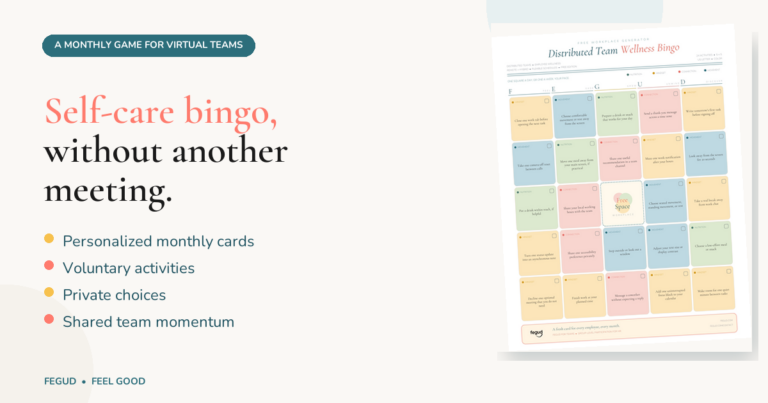
Each employee receives a personalized bingo card with practical activities across Movement, Nutrition, Connection, and Mindset. They complete activities at their own pace, wherever they work. The team plays the same monthly game, but nobody has to complete the same square or share what they chose.
That makes Fegud more than a list of virtual team-building activities. It is one recurring game with enough choice to work across different schedules, locations, abilities, and energy levels.
Ready to try the monthly game with your team? Start your free trial without a credit card.
See the monthly game in action
This 39-second teaser shows the personalized employee card, small self-care activities, and the bingo lines people build during the month.
Employee app preview · 0:39
Want a closer look at the employee experience? Watch the full Fegud app tour.
The problem with adding one more virtual event
Most virtual team building starts with a calendar invitation.
That format can work for a special event, but it also creates familiar problems. Someone is joining outside their normal workday. Someone has unreliable bandwidth. Someone would rather keep their camera off. Someone is catching up after the activity because their work did not disappear while they played.
A distributed team may include home offices, regional offices, coworking spaces, field travel, flexible schedules, part-time employees, freelancers, caregivers, and people working across several time zones. One shared hour is not automatically one shared experience.
Fegud takes a different approach. Instead of asking everyone to be present at once, it gives the team a game that stays open for the month. Participation can happen between meetings, after a task, during a break, or whenever an activity fits the employee’s day.
The monthly card creates the common thread. Synchronized attendance is not required.
What is virtual self-care bingo?
Virtual self-care bingo uses the familiar five-by-five card format, but the squares contain small self-care activities rather than numbers.
In Fegud, each employee gets a personalized card. The activities come from four focus areas:
- Movement: approachable ways to move, stretch, change position, or rest.
- Nutrition: practical ways to eat, drink, or prepare something that fits the day.
- Connection: small ways to reach out, appreciate someone, or feel part of the team.
- Mindset: activities that support reflection, boundaries, attention, or a calmer transition between tasks.
Employees mark activities complete in the Fegud mobile app. Web access supports the broader program experience, and employers can also use a printable card when a physical option is helpful.
The goal is not to race through the board. There is no need for a public individual leaderboard or proof photo. Employees build bingo lines through choices that make sense for them.
How Fegud’s monthly game works
The format stays simple from one month to the next.
1. Each employee receives a personalized card
Employees choose their focus area and difficulty preferences. Fegud uses those choices to create a monthly card from its self-care activity library.
Two coworkers may be playing the same game while seeing a different mix of squares. Personalization gives people room to choose what fits without turning the experience into a completely separate activity for every person.
2. The card opens for the month
The team receives a fresh game each month. Employees can see the full card, complete one square at a time, and build toward bingo during their normal routine.
A month gives the game room to breathe. Missing a day does not mean missing the event.
3. Employees play at their own pace
An employee in Toronto might complete a square before lunch. A teammate in London might choose a different activity near the end of their day. Someone working flexible hours can join when they are actually available.
Nobody needs to wait for headquarters to start the game.
4. The team sees shared momentum
The card creates a common monthly experience, even when participation is asynchronous. Teams can recognize that the game is underway, celebrate collective milestones, and talk about the experience without asking anyone to reveal a private activity history.
5. A new card keeps the ritual moving
The next month brings a new personalized card. The basic game remains familiar, while the activities change. HR does not have to invent a new virtual event every few weeks to keep the experience going.
What can appear on a Fegud bingo card?
The squares are the activity ideas. They are not separate programs, extra events, or another list for HR to organize.
A personalized card might include activities such as:
| Focus area | Possible bingo squares |
|---|---|
| Movement | Choose seated or standing movement; rest your eyes for 20 seconds; step outside or look out a window; take one real break from work chat |
| Nutrition | Keep a drink within reach; prepare an easy snack; eat one meal away from your screen; choose a food option that fits your day |
| Connection | Thank someone in another time zone; send a kind message; share a useful tip in a team channel; message a coworker with no reply required |
| Mindset | Close one unused tab; write tomorrow’s first task; add a focus block to your calendar; log off at your planned time |
The mix matters. A card built only around movement would not suit every employee or every day. Fegud gives people several ways into the game, including low-energy and accessible options.
Participation is voluntary. Employees can adapt or skip activities that do not fit their circumstances. CCOHS also recommends considering employee needs and preferences and offering choices when planning workplace well-being activities.[1]
How one game works across time zones
Fegud is asynchronous by design.
That does not mean employees are playing alone. It means the shared experience is not tied to one hour on the calendar.
For virtual and distributed teams, that changes the practical requirements:
- no camera-on attendance;
- no single start time;
- no facilitator needed for every activity;
- no requirement to show a home, meal, body, family member, or personal workspace;
- no disadvantage for joining later in the day; and
- no need to add another meeting to participate.
The monthly window also works better for teams with part-time schedules, field days, travel, shift differences, or employees who cannot reliably step away at the same time.
If you are evaluating the wider program fit, the guide to wellness programs for distributed teams explains how Fegud handles access, rollout, reporting, and remote-work considerations beyond the bingo game itself.
What the team shares, and what stays private
The team shares the game, not each person’s self-care record.
Employees can know that coworkers are participating in the same monthly bingo experience. They can build momentum around the season, recognize a group milestone, or talk about a square they choose to share.
They do not have to disclose which activities they completed.
HR does not receive individual activity histories. Fegud provides group-level participation information so People teams can understand overall program use without turning managers into self-care monitors. You can review the sample HR report to see the type of information HR receives.
That boundary is important. A voluntary wellness activity feels very different when an employee expects their manager to inspect every choice.
A virtual team-building game should still leave room to pass
“Optional” should mean optional.
Managers should not take attendance, ask why someone skipped an activity, or treat visible participation as proof that an employee is committed to the team. Cameras, public sharing, and personal disclosure should remain optional too.
The Centers for Disease Control and Prevention recommends fitting workplace health efforts to the employee population and involving employees early rather than assuming one format will suit everyone.[2] In practice, that means explaining the game clearly, giving people real choices, and asking for feedback after they have had time to try it.
Fegud is a workplace wellness activity program. It is not clinical care, an employee assistance program, or a replacement for safe working conditions, appropriate workloads, benefits, accommodations, or professional support.
How to introduce Fegud to a virtual team
A simple launch is enough.
- Explain the game. Tell employees they will receive a personalized monthly self-care bingo card.
- Set the privacy boundary. Make it clear that individual activity choices are private and HR receives group-level information.
- Make participation genuinely voluntary. Employees can join, adapt an activity, or pass without explaining why.
- Show where to play. Give employees the app access they need and include a printable option where useful.
- Let the month run. Do not turn each square into a separate meeting or reporting task.
- Review the group experience. Ask whether the game was clear, accessible, and easy to fit into real working days.
Prefer to talk it through? Book a product walkthrough to see how the monthly game works for employees and HR. If you would rather play before deciding, request a Break Room invite to join a game with other HR and People leaders.
Frequently Asked Questions
Is self-care bingo a virtual team-building activity?
Yes. Fegud’s self-care bingo gives a virtual team one shared monthly game while allowing employees to complete personalized activities at their own pace. It creates a common experience without requiring everyone to attend at the same time.
Can employees participate without turning on their cameras?
Yes. Fegud does not require a camera-on session. Employees complete activities privately through their monthly cards, which makes the game usable across different locations, bandwidth conditions, and comfort levels.
Does everyone receive the same bingo card?
No. Employees receive personalized monthly cards based on their focus area and difficulty preferences. The team shares the format and monthly rhythm, while each person may see a different mix of activities.
Can the game work across several time zones?
Yes. The game stays open through the month, so employees can participate during their own reasonable working hours. There is no single live session that every region must attend.
What can HR see?
HR receives group-level participation information. Employers do not see an employee’s individual activity choices or personal activity history.
How often does the bingo card change?
Employees receive a fresh personalized card each month. The recurring format stays familiar, while the activities change.
Is Fegud only for remote teams?
No. Fegud can support remote, distributed, hybrid, in-office, freelance, shift-based, and deskless teams. This article focuses on the virtual team-building experience, but the monthly game is not limited to one work model.
Sources
[1] https://www.ccohs.ca/oshanswers/psychosocial/wh/wellness_program.html CCOHS: Workplace Health and Well-being Promotion [2] https://www.cdc.gov/workplace-health-promotion/php/model/building.html CDC: Strategies for Building a Workplace Health Program