
Wellness programs for remote employees
Employee Wellness Programs for Distributed Teams
A wellness program for remote employees should work across time zones without adding another required meeting. It should give employees private, voluntary choices they can use asynchronously, while HR sees group-level participation rather than anyone’s individual activity.
For HR and People leaders supporting remote, hybrid, dispersed, freelance, and global teams across different schedules and locations.
See it in action
What your team actually sees
A short look at the Fegud employee app: the personalized monthly card, the small activities, and the bingo lines people build over the month.
What employees do in the app is never visible to their employer. HR sees only group totals and averages.
Distributed work changes the program
Remote wellness programs need to work without one shared location, schedule, break room, commute, or camera-on meeting.
One team may include home offices, coworking spaces, regional offices, field travel, flexible hours, part-time schedules, caregivers, and people working in several languages. A useful program has to account for:
- time zones and local working hours;
- home privacy and the right to keep cameras off;
- different abilities, languages, energy levels, and access needs;
- uneven access to quiet space, equipment, or a separate work area;
- employees, contractors, and freelancers working on different schedules; and
- the difference between an optional activity and another required meeting.
A useful program does not turn home life into company content.
What remote-friendly activities look like
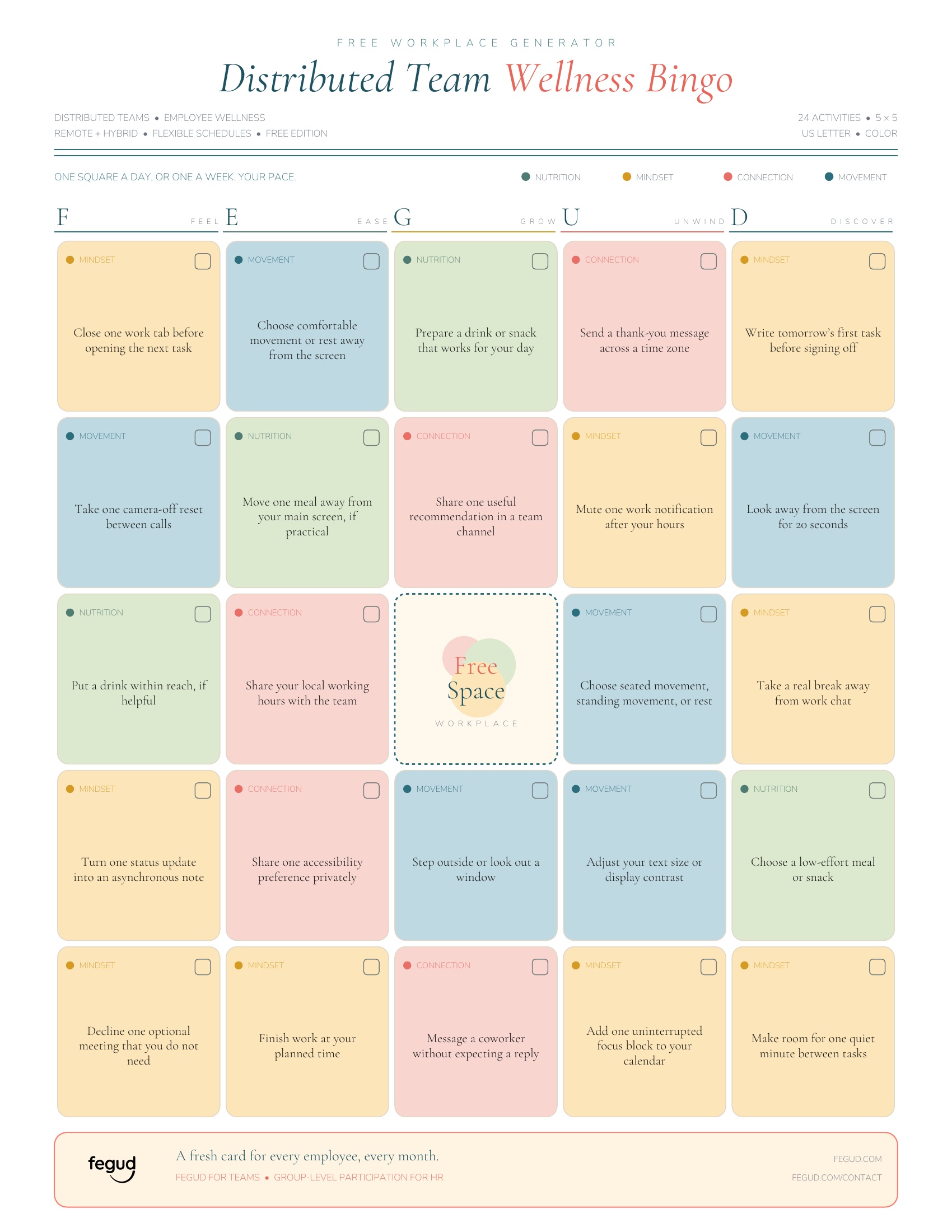
These eight activities appear on the printable Distributed Team Wellness Bingo card. They can be completed asynchronously without a camera, location check, home tour, fitness score, or public proof. Employees can skip an activity, adapt it privately, or choose something else.
Movement
Choose a comfortable movement or rest away from the screen
Use personal time or a real break. Seated movement, standing movement, a short walk, or rest are equally valid.
Movement
Take one camera-off reset between calls
Step away, look elsewhere, adjust your position, or sit quietly. No camera or proof is required.
Nutrition
Prepare a drink or snack that works for your day
Choose based on your needs, culture, budget, access, and personal guidance. Skipping is always an option.
Nutrition
Move one meal away from your main screen, if practical
Use the space and timing available to you. This should not shorten a break or interrupt required coverage.
Mindset
Close one work tab before opening the next task
A small transition can mark the end of one task. It does not replace manageable workloads or clear priorities.
Mindset
Write tomorrow’s first task before signing off
Keep it brief and private. This is an optional end-of-day cue, not an expectation to plan outside paid work time.
Connection
Send a thank-you message across a time zone
Name one specific contribution. A reply is not required, and public recognition stays optional.
Connection
Share one useful recommendation in a team channel
A book, tool, recipe, public resource, or ordinary tip works. Keep participation optional and non-commercial.
Download the free Distributed Team Wellness Bingo card It is an example of the activity format, not a complete workplace wellness program.
Why one virtual event can miss distributed teams
A live game can create one shared moment. It can also exclude people whose time zone, working hours, caregiving responsibilities, bandwidth, accessibility needs, or camera preferences do not fit that event.
The bigger problem comes next. The event ends, and HR has to build another campaign from zero.
A recurring program gives employees private choices across Movement, Nutrition, Mindset, and Connection on a predictable monthly rhythm. Use the dedicated virtual team-building activities guide for one-time games and shared activities.
What a recurring program looks like across time zones
The card arrives on the first of the month for everyone. Employees use it when their own schedule allows.
New hires
New employees join the company program and receive the current monthly card without waiting for a separate campaign.
Asynchronous weeks
Activities stay available across the month. No headquarters time zone becomes the default participation window.
Meeting-heavy weeks
Camera-off, low-energy, and private choices keep the program from becoming another call.
Travel and coworking
Employees can choose activities that fit the place they are working without sharing that location with HR.
Local holidays
People can use a rest day, skip activities, or return later without losing access to the program.
Month to month
Each month brings a new personalized card. HR does not need to relaunch the program.
What distributed employers still own
Wellness never transfers employer responsibilities to employees. Employers still own:
- manageable workloads, staffing, and clear priorities;
- reasonable schedules and time-zone fairness;
- breaks, time off, and the right to disconnect where it applies;
- safe work design and appropriate equipment;
- reasonable accommodations, benefits, and EAP access; and
- emergency support and appropriate professional care.
CCOHS describes workplace health and well-being as a shared responsibility that includes the physical and organizational work environment, not only individual choices.1 Equivalent obligations apply under the laws and regulators of other jurisdictions.
Wellness activities belong around that foundation. They cannot replace it.
What Fegud adds to a wellness program
Enrollment without a work email
HR can share a join code or link. An employee signs up with an email they can access, requests to join the company, and appears in HR’s approval queue.
English, French, and Spanish
Each employee chooses the language that works for them, so a distributed team does not need a separate campaign for each supported language.
Private personalization
Employees choose focus areas, difficulty, and private adaptations. Those choices are not visible to the employer.
Monthly variety
Each employee receives a personalized 24-activity card each month across Movement, Nutrition, Mindset, and Connection.
Group-level reporting
HR sees company participation and named department or team patterns for groups of three or more members. Smaller groups are combined so no individual can be identified from a group’s numbers.
Voluntary participation
Employees can skip or change an activity. Participation should never affect performance reviews, attendance, scheduling, discipline, accommodations, benefits, or time off.
How to roll it out across a distributed team
- Map the workforce. Include locations, time zones, languages, schedules, accessibility needs, work-email access, and local communication channels.
- Set the boundary. Participation, cameras, sharing, and personal disclosure remain optional. The program does not enter performance review.
- Choose asynchronous access. Give employees the month to use the card without joining one live session.
- Launch one monthly card. Explain what employees control and what HR can and cannot see.
- Review group patterns. Use eligible group-level reporting to improve access and communication, not to compare individuals or time zones.
A simple rollout can start in about 30 minutes. The trial lets your team test enrollment and the employee experience before making a commitment.
What HR actually sees
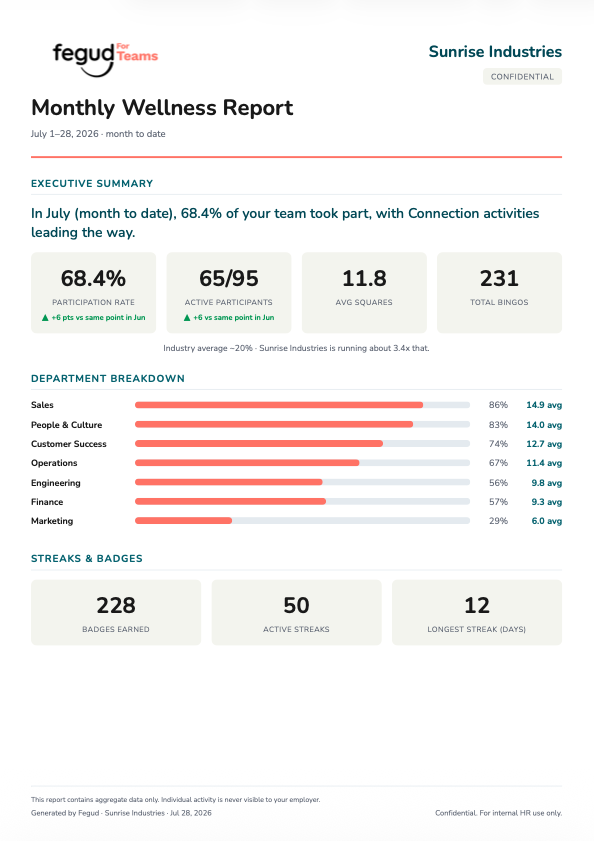
Fegud’s HR report is built around program-level information:
- company participation and active-member totals;
- named department and team patterns for groups of three or more members, with smaller groups combined;
- focus-area mix, badges, streaks, and bingos; and
- a program-level suggestion for the next month.3
The monthly report does not show employee names, locations, camera use, individual activity histories, private answers, notes, or personal wellbeing profiles.4
Review the sample report or read the Fegud Privacy Promise.
Is Fegud a good fit for your distributed team?
Fegud is a strong fit for distributed organizations that want one recurring, voluntary program across locations and time zones without giving HR access to individual wellness activity.
Fegud is a good fit when you need
- one program across remote, hybrid, dispersed, freelance, and global teams;
- asynchronous and camera-optional participation;
- personalized monthly activities instead of one annual challenge;
- English, French, and Spanish;
- private activity adaptations chosen by the employee; and
- group-level reporting that stays separate from productivity and location data.
Fegud is not designed to replace
- manageable workloads, staffing, or time-zone fairness;
- breaks, time off, benefits, or accommodations;
- an EAP, clinical care, or emergency support; or
- productivity, location, attendance, camera, or individual employee monitoring.
If the goal is voluntary monthly participation across schedules while keeping individual activity private, Fegud belongs on the shortlist.
How to evaluate Fegud before you commit
Fegud is new, and we do not publish participation numbers we cannot show you how we measured. Each step below answers a different question, and you can stop at any of them.
Step 1
Play the card yourself
Join The Break Room and use the real monthly card before you ask anyone else to.
Step 2
Read the sample report
See exactly what HR receives each month, and what it leaves out by design.
Step 3
Try it with your team
Test enrollment, languages, and the employee experience for 7 days. No credit card.
Not ready to run a program yet? Take the free Burnout Audit to see where your team is starting.
Pricing for your team
Fegud prices plans by employee count in USD.
| Plan | Team size | Annual price | Monthly billing |
|---|---|---|---|
| Starter | Up to 25 employees | $1,990 per year | $199 per month with a 12-month commitment |
| Growth | Up to 100 employees | $6,990 per year | $699 per month with a 12-month commitment |
| Business | Up to 250 employees | $14,990 per year | $1,499 per month with a 12-month commitment |
| Business Plus | Up to 500 employees | $24,990 per year | $2,499 per month with a 12-month commitment |
| Enterprise | 501 or more employees | Custom | Contact Fegud |
Choose the next step by company size
- Up to 100 employees: play the monthly card in the Break Room first, then start your free trial.
- Up to 250 employees: review the sample report, then book a demo to discuss Business-plan reporting and rollout.
- Up to 500 employees: review the sample report, then book a demo to discuss Business Plus reporting and rollout.
- 501 or more employees: book a demo for Enterprise setup, security review, integrations, and support.
View the sample report | Book a demo | Compare all plans | Start your free trial
Remote employee wellness program questions
How do wellness programs work for remote teams?
A remote wellness program gives employees activities they can access from different locations and schedules without requiring one live event. Fegud provides a personalized monthly card in its mobile app, with voluntary activities across Movement, Nutrition, Connection, and Mindset. HR manages the program and sees group-level participation, not individual activity.
Can employees participate across different time zones?
Yes. Fegud activities can be completed asynchronously during the month. Employees do not need to join one call or participate at headquarters’ preferred time. Employers should still protect local working hours, breaks, time off, and the right to disconnect.
Do remote employees need to use their cameras?
No. Fegud does not require cameras, video calls, home tours, photos, or personal disclosure. Employees choose activities privately and can skip or adapt anything that does not fit.
What does HR see about remote employee participation?
HR sees company participation and named department or team patterns only for groups of three or more members. Smaller groups are combined. HR does not see an individual employee’s completed or skipped activities, private adaptations, notes, or personal wellbeing answers.
Does Fegud track an employee’s home or work location?
No. Fegud is not a location, time, productivity, or attendance tracker. It does not show managers where someone completed an activity or whether they joined from home, an office, or another approved work setting.
Is virtual team building the same as a remote wellness program?
No. Virtual team building usually centers on one shared game or event. A remote wellness program offers a recurring activity rhythm across weeks or months. The two can connect, but a one-time event is not a full wellness program.
Is Fegud a good fit for a distributed or global team?
Fegud can fit distributed teams that want voluntary monthly activities, asynchronous participation, private personalization, English, French, and Spanish access, and group-level reporting. It is not clinical care, an EAP, a productivity tracker, or a replacement for safe workloads, benefits, accommodations, or professional support.
Other industries
Fegud shapes the monthly card for each kind of workplace. Browse wellness programs by industry, including manufacturing, hospitals, and warehousing.
For adjacent remote-team questions, browse remote wellness challenge ideas or the virtual team-building activities guide.
Sources
- CCOHS, Workplace Health and Well-being Promotion. Accessed October 10, 2026.
- Virtual Teams: Taking Stock and Moving Forward. Accessed October 10, 2026.
- Fegud sample monthly wellness report. Accessed October 10, 2026.
- Fegud Privacy Promise. Accessed October 10, 2026.
- Fegud for Teams. Accessed October 10, 2026.
- Fegud employee wellness program pricing. Accessed October 10, 2026.
See the report before you book.
Review the exact group-level information HR receives, then decide whether Fegud fits your distributed team.
